High Country, chapter 3 of The Cowboy Who Bought My Ranch
The storm showed up on Monday the way the bad ones do, as a color first. By seven the sky over the Bighorns had gone the yellow-gray of an old bruise, and the wind had dropped to nothing, which is worse than wind.
“Eleven pair still up on the permit,” Wade said at breakfast. “Maybe twelve. The Forest Service wanted us off two weeks ago.”
“You’re late,” I said.
“I had an auction to go to.”
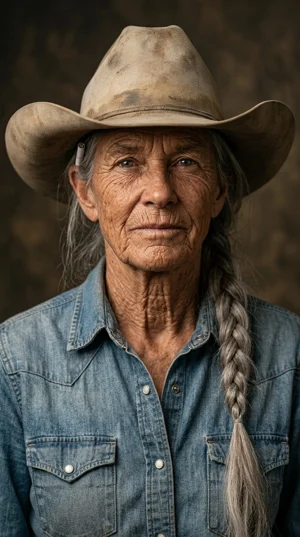
Cass Moody laughed into her eggs. She’d ridden for the Rafter G for twenty years and for my grandmother for twenty before that, a bowlegged woman of sixty-three with a gray braid down her back and a face like a good saddle. She rolled her own cigarettes and never lit them. She’d roll one at breakfast, put it behind her ear, and it’d still be there at supper, a little bent.
“Jo’ll ride with us,” Wade said.
It wasn’t a question, and for once I didn’t mind. I’d have ridden up there in my socks.
He gave me a big bay gelding called Dutch who had a mouth like a velvet glove and opinions about water crossings. We trailered to the top of the Rafter G and rode on from there, four of us strung out on the old two-track through the timber, Wade and Cass and me and a lanky kid named Royce Bauer who was twenty-three and still rode like he was trying to impress somebody.
I hadn’t been up that high since August. It hit me in the chest. The lodgepole was black-green and close, the ground under it soft with needles, and then the timber broke and the parks opened out above us, big tilted meadows of cured grass gone the color of a lion, with the granite above them and the sky pressing down on all of it. The air smelled like snow. It smelled like iron and pitch and cold water, and it was so quiet I could hear the creak of Dutch’s cinch and Cass humming some old Patsy Cline song under her breath, off-key.
We found nine pair in the first two hours. They came easy, the way cows do when they already know winter’s coming and they’d just as soon somebody else made the decision. Wade and Cass pushed them down toward the gate. Royce and I rode the edges.
That’s where I found the other two.
There’s a draw that comes down off the north side of that big park, steep, with willows in the bottom and a seep that never freezes all the way. Royce rode right past the head of it. I saw why: from the top it looked like nothing, just willows. But a cow that’s lost her bunch with a late calf at her side will tuck into a place like that and stand so still you’d swear she’s a stump, and I’d been looking at cows like her all my life.
“Royce,” I said. “Hold up.”
“There’s nothing down there.”
“There’s a black baldy with a split ear and a calf about the size of a big dog,” I said. “And she’s going to come out of there like a freight train the second she figures out we’ve seen her, so get yourself below her, honey, and don’t be in the willows when she does.”
He looked at me like I’d grown horns. Then he looked down the draw, really looked, and I saw his face change.
She came out exactly the way I said she would.
I won’t tell it all. It was a good ten minutes of Dutch earning his oats, and the cow trying three times to cut back up the hill, and the little calf bawling and running in the wrong direction with his tail straight up like a flag, and Royce finally getting below them and doing it right. When we brought the pair up out of the draw Wade was sitting his horse at the top, watching.
He didn’t say anything. He just touched the brim of his hat to me.
Cass rode up alongside and stuck her unlit cigarette in the corner of her mouth.
“Your Gran used to do that,” she said. “See a cow nobody else could see. Drove the men crazy.”
“I know.”
“You know about the vulture thing?”
I glanced at Wade’s back, up ahead. “Everybody knows about the vulture thing.”
“Stock Growers banquet,” Cass said, with real pleasure, as if I hadn’t spoken. “Twenty sixteen. At the Elks. He’d sent her an offer that week, a good one, and she walked across that room in her church dress and stood in front of his table and said, Wade Garrity, you are a vulture, and I will be dead and buried before you get one drop of my creek. Whole room heard it.”
“What did he say?”
“He stood up. Took his hat off. Said, Yes ma’am.” Cass grinned around the cigarette. “And then he went and paid for her prime rib. She was madder about that than anything. Talked about it for a year.”
I laughed. It surprised me. It hurt, too, like laughing does when you’ve been hit.
The snow came when we were bringing the last of them through the wire gate at the bottom of the permit.
It came the way it does in the high country, not falling so much as arriving, the whole sky suddenly thick and white and moving sideways. The gate was an old Wyoming gate, four strands of barbed wire stapled to a stick, held shut with a loop of wire over the post. The kind you have to fight. I got off Dutch to open it, and the wind took the stick out of my hands, and the top strand went across my left palm like a knife across a cutting board.
I didn’t make a sound. You don’t, in front of a man’s crew. I closed the gate on the last calf, got back on Dutch, and wrapped my hand in my rein.
I rode the whole way down with blood soaking into the leather. It was an hour before he saw it.
We were unloading at the barn in the blue snow-dark, the yard lights coming on, the cows bawling in the corral and the wind gone around to the north. I handed him Dutch’s reins and he took them, and stopped, and looked at his own hand, and turned my rein over.
“Jo.”
“It’s nothing.”
“Tack room,” he said. “Now.”
The tack room was warm from a little propane heater and smelled like saddle soap and horse and old leather and the sharp green bite of liniment. There was a sink in the corner, a deep steel one, and a bare bulb over it. He ran the water until it was warm and took my wrist and held my hand under it, and I hissed, and he didn’t let go.
“Barbed wire,” he said.
“That gate on the permit’s a disgrace. Somebody ought to put in a real one.”
“Somebody ought to.” He turned my hand over in his. The cut ran across the heel of my palm, not deep, but long and ugly and full of grit. “You rode down like this.”
“I’ve ridden down with worse.”
“I know you have.” He said it low. “That’s the problem.”
He cleaned it slow. He had a brown bottle of something that stung like fire and a roll of vet wrap, and his hands were very big and very careful, and he held my hand flat in his left one under that bare bulb like it was a thing he’d been handed to keep. His thumb moved along the inside of my wrist, once, where the pulse is. I don’t think he meant to. I don’t think he knew he’d done it.
I knew.
I stood there in his tack room with snow ticking on the one small window and my hand in his and my whole body gone quiet and listening, the way a field goes quiet just before the hail. I hadn’t been touched like that in years. Not like a wife. Like a person somebody was paying attention to.
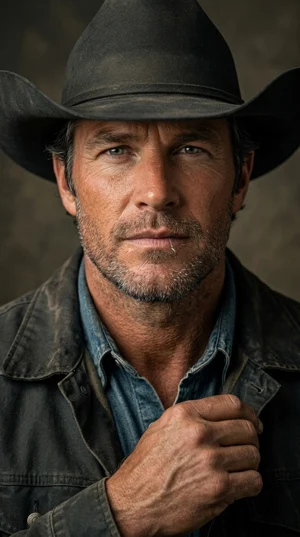
He was close. Close enough that I could see the snow melting in his eyebrows, the gray coming in at his temples, the small white scar at the corner of his mouth I’d never been near enough to notice. He smelled of horse and cold air and that clean skin smell again. He wasn’t looking at my hand anymore.
“Wade,” I said.
“I know.”
He didn’t move. He waited. That was the thing about him. He’d bid two million dollars in one breath, and then he’d stand in a tack room with my hand in his and wait for me like he had all winter.
My left hand, the cut one, was lying in his. And there on it, an inch from his thumb, was my wedding ring.
I’d worn it sixteen years. A plain gold band, a little thin now on one side from fence pliers and calving chains. Grant had bought it in Billings. I used to think that was romantic.
I took my hand back, and with my good one I took the ring off.
It didn’t want to come. Knuckles get bigger after forty, and mine were swollen from the cold. I worked it over, wincing, and it came free all at once, and I set it on the shelf over the sink next to a can of hoof dressing and a bottle of Absorbine, where it looked small and cheap and like it belonged to somebody else.
When I looked up he was looking at the ring. Then at me. Then at my mouth.
He leaned in. Just a little. Just enough that I could feel the warmth coming off him.
I wanted it. God, I wanted it, the way a cow that’s walked all day wants the tank. I wanted to find out what that mouth did when it wasn’t saying yes ma’am to my grandmother.
I put my good hand flat on his chest and stopped him.
His heart was going hard under my palm, as hard as mine. That surprised me more than anything.
“Not with his ring an inch away,” I said. “When I kiss you, it’s going to be because I picked it. Not because I’m bleeding in your barn.”
He looked at me a while longer. Then he nodded, once, and stepped back, and the cold came in between us like a draft under a door.
“All right,” he said. His voice had gone rough. “When you pick it.”
Frances had left a copy of the power of attorney on the kitchen table the day before, and after supper, with my hand wrapped up like a boxer’s and Mule asleep on my foot, I made myself look at it.
I hadn’t, really. Not properly. I’d looked at it like a wreck on the highway, from the corner of your eye, not wanting to see who was in it.
Now I put it under the lamp and looked at my name.
Josephine A. Kessler.
Upright. Careful. All the letters there in the right order and none of them alive. Grant had done a good job, I thought, almost admiring. He’d had sixteen years of my signature to practice on.
Then I saw the K.
There was a gap in it. A tiny one. The long down-stroke of the K broke for a hair, a skip, as if the pen had hopped over something, and then went on.
I sat very still.
I don’t skip. I sign fast and I sign hard and the pen never leaves the paper. But I had skipped once. One time in my life, I’d signed my name and the pen had jumped right there in the K, and I remembered it because I remembered everything about that day: a hailstorm in June, sixteen years ago, my grandmother’s old Ford in the lot at the brand office, the paper laid on the hood because we couldn’t wait to get inside, the pen hitting the seam in the hood just as I came down on the K. Gran laughing at me. Now you’ve gone and made it look like a brand, Josie.
The day she transferred me the Seven-Bar.
The copy of that transfer was in the brand book. It had been there ever since, tucked inside the front cover where she put it.
And the brand book was in Grant’s hands.
Wade had come in behind me. I hadn’t heard him. He was standing in the doorway with a dish towel over his shoulder.
“Jo?”
I put my finger on the gap in the K.
“He traced it,” I said. “He traced it off the day my grandmother gave me the brand.”
What did you think?