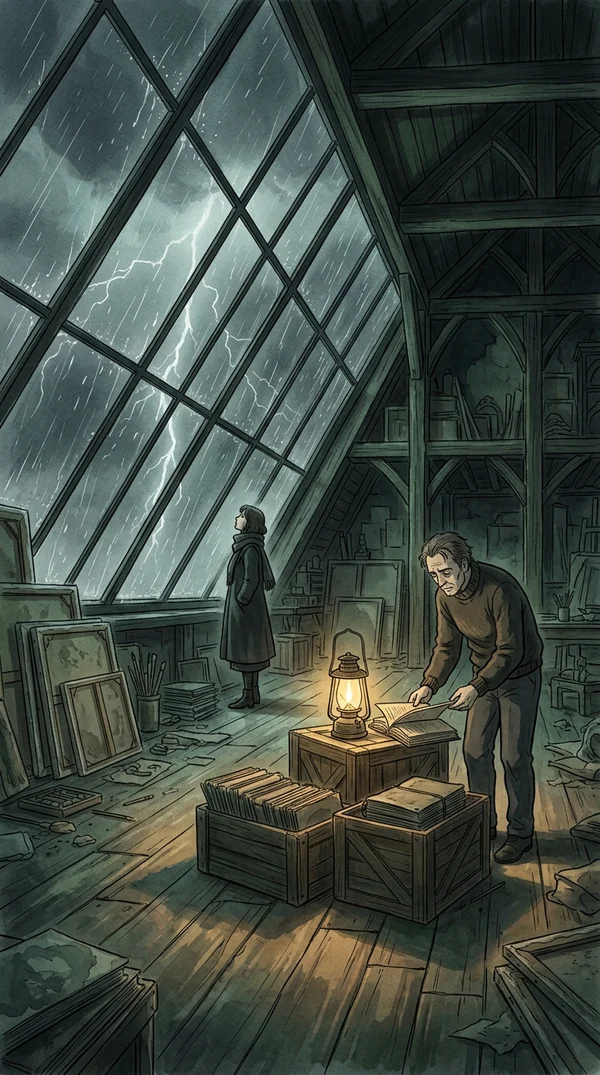
She left her treatment notes on the attic table, squared to the edge, with a sheet on top in block capitals: FOR THE NEXT CONSERVATOR. Then she stood looking at it, because she understood exactly who the next conservator would be. Someone like Maren. Someone who would read these notes in fifteen or twenty years in this same north light, with her own face looking down at her from the wall.
She left them anyway. There was nothing else to leave.
At twenty to seven the tide was out and the boardwalk was dry and gray with dew. She carried her case in one hand and the camera bag on her shoulder and did not look back at the house until she was halfway across. Then she did. It stood in its ring of reeds with the north wing in the water and every window blind, and nobody was at any of them.
She had wanted somebody to be. She hated that she had wanted it.
Lavinia was on the store dock with the mail sack.
Of course she was. She ran the post office. As Maren came off the boardwalk Lavinia straightened from the bollard and looked at the case, the camera bag, and then Maren’s face, and nodded once, as if confirming a delivery.
“He told you,” she said.
“He told me.”
“Well.” Lavinia put her hands in her cardigan pockets. “Then I won’t waste your time pretending. Sit down a minute. Wash is late. Wash is always late.”
Maren did not sit. Out on the Sound mist was lifting off the water in the first sun, and beyond it, faint, the Miss Lettie’s diesel came around the point.
“Two hundred and eleven people,” Lavinia said. “That’s the Ridge, last count. Eleven children in the school. The church. My mother’s grave and her mother’s. All of it on a hump of mud you could walk across in fifteen minutes, in the middle of a bay that’s eating every other island in it.” She said it without heat. “I know you think it’s superstition. I thought so too, when I was young. I went off to Baltimore and learned to paint and told myself it was old women’s talk. Then I came home and watched the West End go, a house a year, and watched the water come up the aisle of my church to my hip. And I watched that house stand dry above it all. Every time.”
“Your house flooded last year.”
“Because it had been sixteen years without a keeping. Because my nephew wouldn’t.” Lavinia’s voice did not rise. “Anne knew everything you know, Maren. I told her myself, that summer, before she touched a brush. And she chose it. Twenty-three years in that house, and most of them she was happy. A husband who loved her, a boy she adored, that studio. She chose it.”
“She went over the side of a boat.”
“She did.” Something moved in Lavinia’s face and was put away. “And you think if you get on Wash’s boat this morning it’s finished? It isn’t, honey. It’ll choose again. Somewhere tonight there’s a girl brushing her teeth in Ohio or wherever, and in a few years those faces will start turning into hers, and one day she’ll open a letter.” She spread her empty hands. “You can go. Nobody’s going to stop you. I just want you to know what you’re choosing when you go.”
The Miss Lettie came out of the mist, and Wash throttled back, and she drifted in on her own wake and touched the dock as softly as a hand.
Maren handed Wash her case and stepped down into the boat.
The harbor mouth was flat calm. The water was the color of pale tin and so still that the bow wave went out across it in two long lines that did not break. They passed the last crab shanty. A man on its dock lifted a hand to Wash, and Wash lifted two fingers off the wheel.
“That’s the Gut,” Wash said. “Coming up.”
She could see it. A darker band running across their path, where the bottom dropped away and the channel ran deep between the island’s marsh and the open Sound. It looked like nothing. It looked like a shadow. A mother and a sixteen-year-old boy had come down this harbor in water like this, in a white skiff, and the mother had been shaking.
Maren sat on her case in the stern and waited to feel something.
The engine through the bench. The sun on the side of her face. They crossed into the dark water and the boat did not change its note, and nothing touched her, and nothing took her by the ankle, because nobody had kept her. She was nothing to this water. She could go.
She turned and looked back.
Sounding stood on its hummock above the marsh, a small brick block in the morning light, the north wing standing out into the water like a horse in a river. From here you could not see the six portraits in the attic, each with a stranger’s face under the varnish, each stranger a woman who had been hired, and come, and been looked at, and stayed. Seven, with the one on the north wall. And an eighth somewhere tonight, brushing her teeth.

 100 to start reading with.
What did you think?