Lydia Fenn went on Monday morning, and smelled of ether.
It came up out of the canvas as the last of Maren’s face came off the black bombazine, sharp and sweet and chemical, the smell of a darkroom in 1880, of collodion and varnish and the little bottles of tint a colorist kept for putting the pink back into dead men’s cheeks on their memorial photographs. Under it was a woman of forty with a pointed chin and very black eyebrows, who looked as though she had spent her life being asked to make other people look alive. Somewhere in the house there was a small hard click, like a shutter closing. Then the groan of the beams, longer than Friday’s. August went down to the ledger and came back up and said, “Three inches,” and sat down on the floor by the door with his back to the wall.
Agnes on Tuesday, the woman in the blue hat whose brown eye had started all of it. Maren opened her up from the test window outward, gently, like finishing a sentence someone else had begun. The face under her own was broad and humorous, the mouth turned down at one corner exactly as the infrared had promised. When the last swab came away the limp gray plume on the hat seemed to lift, very slightly, though nothing in the attic moved, and the north glass rang once like a struck bell. Below them, in the north wing, a beam cracked with a sound like a dropped plank.
“Floor joists,” August said, when he came back. “In the Water Room. The tide’s not going out of there any more. It stands at the well-curb at low water now. It doesn’t drain.”
Hazel on Tuesday afternoon, because Maren could not stop. Turpentine, and a gust of cold air from nowhere that turned the pages of Joan’s notebook on the long table, a dozen of them, fast, and laid it open at a sketch of a solemn little girl with bangs. Hazel’s face was square and freckled, with paint in the crease of her knuckle that the painter had put in on purpose. Five inches.
Joan on Wednesday morning, and the attic filled with cigarette smoke so thick that Maren coughed, and then it was gone, as if a window had opened. Joan Pettibone had a narrow sardonic face and a gap between her front teeth. She was looking off to the left, out of the frame, toward the stair. Toward the Water Room, Maren thought. She had always been looking toward the Water Room.
Agnes had cost four inches. Joan cost six. August wrote every one of them down.
Anne was last.
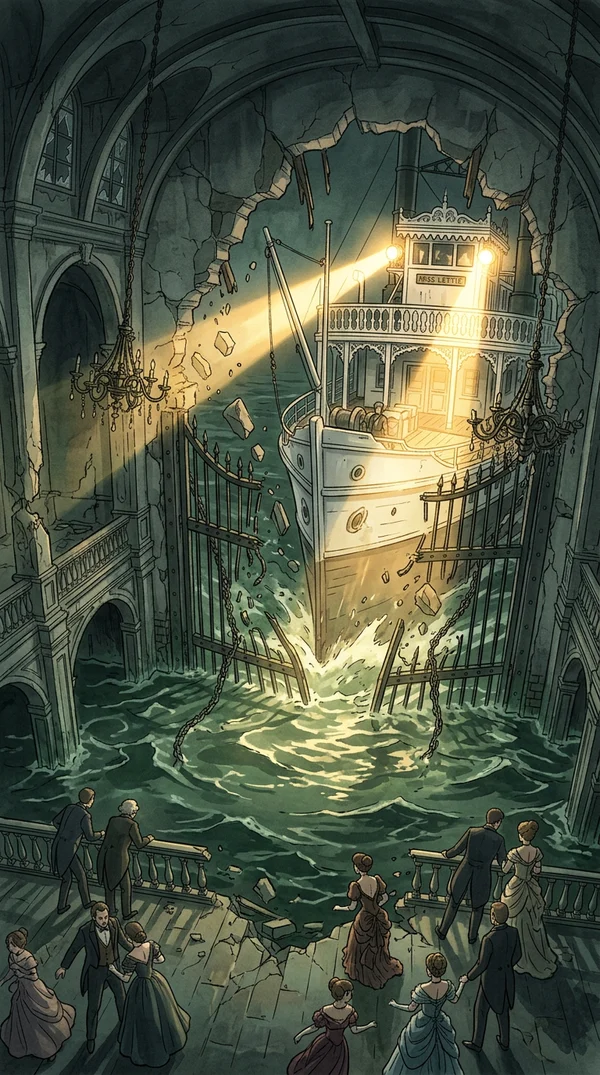
He held the lamp. He had not held it since the morning she left on the Miss Lettie, and he did not ask if he could. He just picked it up off the floor when she set out the bowl of cistern water and the swabs for the woman in the cream sweater, and stood where he had stood that first week, and moved it when she moved, a second before she needed him to.
She went slowly. Her own face came away by inches, and the face under it was patient work, Lavinia’s careful small brush, a young woman painted by a friend, every lash accounted for. Clear blue eyes, amused. A line under each from laughing. The mouth just beginning to smile, as though the painter had said something and she was about to answer. A front tooth showing, very slightly crooked.
When the last swab came away, the attic smelled of cut grass and hot stone, like a garden in June.
August set the lamp down on the table.
“Hi, Mom,” he said.
That was all. He did not touch the painting. He stood in front of it with his hands at his sides and looked at her, and his face did not do anything, and Maren took the bowl of pink water and the dish of spent cotton and went and stood at the gable window with her back to the room so that he could have it.
She heard the stair before she heard anything else. The same heavy climb as the first day, a woman who had come up too many steps too fast, the hand sliding on the rail. Lavinia came around the last turning in her yellow slicker with the hood pushed back and her braid coming down, and stopped in the doorway, and saw the painting.
She did not say anything for a long time.
“I painted her in the side yard of the store,” she said finally. “June of ’86. She wouldn’t sit still. She kept laughing at something I’d said and I kept telling her to stop and she couldn’t. That tooth.” She came a step into the room. “I thought I’d never see it again.”
“You knew what it was for,” Maren said from the window. “When you painted it.”
“I knew.” Lavinia did not look away from Anne. “I thought if she was going to be kept, she ought to have one with her own face under it. I thought that was a kindness. I thought I was being kind.”
Maren crossed to the table and turned the camera around and held it out. On the screen, enlarged, the brown iron-gall writing, black in the infrared. Beside it she laid open the ledger at Josiah’s son’s hand. Gale from the NE. Water in the ballroom to the mantel. Village not troubled.
Lavinia read them both. She read them slowly, with her glasses on, as she had read the row of portraits that first day. Then she took the glasses off and let them fall on their cord.
“A dead woman’s handwriting,” she said. “And a pencil line from 1851.”
“And your church flooded to the second pew with Anne alive in this house. And with Hazel. You painted the lines yourself, Lavinia, I’d bet on it. The keeping never held the Ridge. It’s held this house over that woman’s painting for two hundred years, and that’s all it’s ever held.”
“Or the Ridge flooded to the second pew instead of the steeple, because Anne was here.” Lavinia’s voice was quiet and steady. “You don’t know. I don’t know. Nobody knows, honey, that’s the whole of it, nobody has ever not done it and lived to write down what happened. And on Thursday night there’s going to be a king tide, the highest of the year, and Wash says the low’s coming up the coast on top of it, and there are two hundred and eleven people on that Ridge, and eleven of them are children. Against that you’ve got a ghost story on the back of a canvas.”
“She wrote it herself.”
“I know she did.” Lavinia looked at Anne. “I poured out your water. The day you carried them up here. You worked that out too, I expect. The receipt says keep the pictures from sweet water and I wasn’t going to have you washing off what you didn’t understand.” She drew a breath. “I’d do it again.”

 100 to start reading with.

What did you think?