Three Shows Nightly, chapter 1 of The Last Real Fall
At Plummet, the eleven o’clock fall started with a drumroll from a speaker that had blown its left channel in August, so it sounded like someone politely knocking on a door.
Tess Ocampo stood on the jump deck under the roof beams and looked at her bag. Twenty-five feet down, it filled the old loading bay of what had been a tile warehouse, blue nylon, nine feet thick, the blower on its far side roaring. Beyond it were forty tables of people who had paid twenty-two dollars to watch a human being do something a human being no longer needed to do, and above them, in pink neon that buzzed on the S, the sign Hal had bought from a guy in Pacoima:
THE LAST REAL FALL IN LA. THREE SHOWS NIGHTLY.
The bar’s three televisions were showing a basketball game nobody was watching. As Hal reached for the microphone, the game cut to an ad: a black screen, a sound like wind across a cable, and a single word in silver. LARK.
She had managed all evening not to see it by not looking at anything. The Nightjar: Vesper trailer had dropped at nine. The fourth picture, the first with Understudy performers in every stunt; the one they had started with humans in the winter and finished, after February, without.
Somebody turned the sound up. Somebody always turned the sound up.
On three screens at once, Dax Holloway ran across a bridge in the rain. Not Dax. A feather wearing Dax: his jaw, his eyebrow scar. The body was something trained on hours and hours of bodies. It ran like you run in dreams.
Imogen Price’s feather ran beside him. Tess’s role. Tess’s run, for six years. The feather took the corner at the center span with its weight dropped into the outside hip, which was how Tess took corners, which was how she had taught Imogen to take them for the close-ups.
The two figures reached the rail. Black water a long way below, lit silver. Feather-Dax looked at feather-Imogen and reached for her hand.
Then he tapped his chest buckle twice with two fingers.
Tess felt it in her teeth.
They went over together in one long falling shot, rain streaking up past the lens, the hands finding each other, the water rushing up. A title card. OCTOBER 30. The bar cheered.
“Turn it off,” Gus said, to nobody, from the rail beside the blower. His voice was ordinary. His hand on the rail was not. It had closed so hard the knuckles had gone pale and smooth.
In her jacket, on the hook at the foot of the ladder, was a letter she had folded into a square the size of a matchbook. It had come at four that afternoon from Ingrid Lindqvist’s lawyer, and it said that the arbitration over Bo’s death would close its record on October thirty-first at ten in the morning. After that the finding stood. Performer released his line prematurely. Bo’s name and that sentence, together, for good.
“Hold,” she said into her collar.
“Holding.” Gus let go of the rail. He was wearing his reading glasses on their cord, and his face in the uplight looked like a disappointed potato. “Problem?”
“Blower’s singing.”
“Blower always sings.”
“Not in E.”
She came down the ladder. The customers hated that part, because a woman climbing carefully down a ladder looked like a woman who had changed her mind. A bachelorette table near the front booed.
A cocktail napkin was sucked flat against the intake grille, white with a pink P in the corner, choking half of it. A bag at half pressure would still catch her. It would just catch her like a sofa catches a dropped plate.
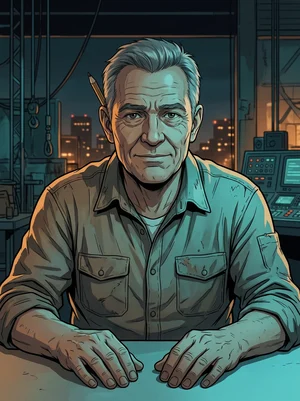
She peeled it off and held it up. Gus wrote something in his notebook, because Gus wrote everything down. He had a spiral-bound book for every year since 1991, and a carpenter’s pencil behind his ear that he sharpened with a box cutter.
“I put a screen on that intake,” he said. “Hal took it off because it made the blower look ‘industrial.’” He did the quotes with the pencil.
She went back up. The bachelorettes cheered, which was worse than the booing. At the top she put her heels on the strip of yellow tape at the deck’s edge, and the noise of the bar went somewhere else. There was the bag and the beam over her head and the sour smell of the rubber matting, and her own breathing, which she counted without meaning to.
Twenty-five feet was a second-story window. She had done twenty-five feet on her first day of stunt school, with a broken toe she had not mentioned.
“Ladies and gentlemen,” Hal said into the microphone at the bar, in the voice he used for raffles, “the last real fall in Los Angeles!”
“Three,” Tess said, very quietly, “two. Mine.”
She went backwards.
The beams turned over. The neon swung past upside down, LAST REAL briefly a word in a foreign alphabet. Her body did its usual thing, the chemical certainty that this was a terrible error, and she let it shout while she kept her chin tucked and her arms out and her back flat. A fall was mostly the art of being a plank with opinions.
The bag took her. Nylon rose around her face, air coughed out of the side vents, and the roar of the blower was suddenly a roar inside her ribs. She lay looking up at the dark rafters and the jump deck, small and very far away, and waited for her heart to remember that it worked for her.
Applause, the kind that goes on a beat too long because people have surprised themselves. A man near the bar yelled, “Do it from the roof!”
Tess rolled to the edge and slid off and bowed, the way Hal liked, one hand on her stomach. Gus did not look at her. He looked at the bag, pressing one fold of nylon with his palm as if smoothing a bedspread. That was what Gus did after every fall. He touched the thing that had caught her.
Hal was waiting at the end of the bar with a cranberry soda and an idea.
Hal Brisco was sixty, wore a fedora indoors, and had opened Plummet because people would always pay to watch somebody be brave.
“Halloween,” he said. “Big week. Lark’s premiere on the thirtieth, the whole town’s going to be thinking about stunts.”
“The whole town’s going to be thinking about feathers.”
“Exactly. And we’re the alternative.” He pointed up, past the jump deck, at the mezzanine where the warehouse had once had a freight office: a rail and a dark window, at least another twenty feet up. “Forty-five. Special show, Halloween night. I’ll double your fee. I’ll put your name on the sign.”
Tess drank her cranberry soda.
“Bag’ll handle forty-five,” Hal said, to Gus, who had come up behind her.
“Bag’ll handle sixty,” said Gus. “The bag isn’t the question.”
Hal waited. Tess put the empty glass on the bar.
“Twenty-five,” she said. “Three shows. That’s the deal.”
“You used to do ninety. You did ninety off the Fourth Street bridge in that thing with the trains.”
“I used to be twenty-eight.”
“You’re thirty-five, not dead.” Hal heard himself a second too late. His face did something complicated under the fedora. “I didn’t mean.”
“I know what you meant.”
“Tess.”
“Twenty-five, Hal.”
She went to get her jacket. Behind her, Gus said something low to Hal that made Hal take his hat off and hold it in both hands.
Tess zipped her jacket and went out through the kitchen into the alley, where it smelled of fryer oil and jasmine from somebody’s fence, and stood against the wall with her hands in her pockets.
In February, on Stage 9 at Lark Pictures, she and Bo Lindqvist had gone over the rail of a bridge set seventy-eight feet above a tank of water. They had been on decelerator lines. She remembered the rain bars and the cold and the yellow tape of her mark and Bo, beside her, tapping his buckle twice. She remembered the first assistant director saying action.
Then she remembered nothing. Four seconds of nothing, by the timecode on the incident report, and then cold water and Gus’s hands under her arms and somebody screaming in a way that was not her.
The version on the bar’s screens was the version where they both reached the water.
The kitchen door opened. Gus came out with a licorice rope, which was what he had instead of cigarettes since 2019. He stood against the wall beside her and bit and chewed and looked at the dumpster.
“It was his flick,” Tess said.
“I know.”
“Two fingers. Twice. Nobody told the machine to do that. Nobody choreographed it. It learned it.” She heard her voice and made it lower. “It learned it from his footage, Gus. From that day. That’s the bridge. That’s our bridge, they rebuilt it in the computer, I know the rivets.”
“I know.”
She took the letter out of her jacket. She had read it at the mailboxes and folded it and unfolded it so many times since that the creases had already gone soft.
“Danae Moss,” she said. “Ingrid’s lawyer. She wrote to all of us. Ten in the morning on the thirty-first, and then the finding stands. That’s what goes on him forever. That’s why his mother doesn’t get the death benefit. That’s why there’s a line about ‘unsafe crew’ on every one of our insurance files.”
“I got the letter.”
“Lark gave the arbitrator wide angles that cut out before. They say the A-camera original was corrupted in the tank. Water damage.” She folded the letter again, smaller. “Danae says copies can be challenged as fakes now, anyway. Anything can. The only thing that can’t is the original. The signed mag. And the one camera that saw it close was the A-cam on the crane, and they say it’s soup.”
“Tess.”
“It isn’t soup. You just watched it. They trained a feather on it. You don’t train a feather on soup.”
Gus chewed.
“Lark keeps original media,” Tess said. “They have to. Their insurer makes them, and it’s on a litigation hold. There’s a vault on the lot. They call it the Icebox.”
“Don’t.”
“I haven’t said anything.”
“You’re about to say a thing that gets you three years in Chino. Don’t.” He took the licorice out of his mouth and pointed it at her. “You want to fight Lark, you fight Lark in the arbitration, with Danae, in a room. You want to break onto that lot? Their system knows how you walk. It’s got eleven years of your motion capture. It’d know you from a helicopter.”
“So I won’t walk.”
“Not funny.”
“Somebody has to get it before the thirty-first.”
“Nobody has to do anything.” He put the licorice back in his mouth and talked around it. “I’m not rigging anything on that lot. I’m not rigging anything for you over forty feet. I’m not doing it, and I’m telling you not to, and that’s the last thing I’m going to say about it.”
“Why not?”
He looked at her. Under the alley’s one light his eyes were wet and furious and old.
“Because I already pulled one of you out of that tank,” he said, “and I’m not built for two.”
He went back in. Through the door Tess heard him tell Hal, in a reasonable voice, that the intake was getting a screen tonight or there was no one o’clock show, and Hal could call that industrial if he liked.
She got out her phone.
The thread was still near the top of her messages, because almost nothing had gone below it in eight months. BAD IDEAS CREW. Bo had named it in Atlanta, after Jonah tried to jump a rental car for a bet. Six names. One of them was gray now, his number disconnected in March, but nobody had removed him, because nobody knew how and nobody had tried.
The last message was from Mars, on February 12: who’s with ingrid tonight.
Below it, Tess’s answer. me.
She took a screenshot of the trailer from the Lark site, the frame where the feather’s two fingers touched its buckle, and sent it into the thread with no words at all.
For a while nothing happened. The fryer fan hummed. Inside, the drumroll knocked politely on its door.
Then, under the picture, a gray bubble appeared with three dots in it. Then a second one. Then a third.
What did you think?