Walk Like Somebody Else, chapter 4 of The Last Real Fall
Gus taught walking the way he taught falling: as if it were very simple and you were very stupid.
“Again,” he said.
Mars walked through the camera frame for the fortieth time. She had borrowed a pair of her cousin’s wife’s church heels, cream, an inch and a half, slightly too big, and she had stuffed tissue in the toes. She walked with her chin tucked and her handbag clamped under one arm and a look on her face of a woman who had seen what you did at the christening and would be mentioning it to your mother.
VELA, M. 34%.
“Under forty,” Gus said. “Good. Now do it for five hours.”
“I hate this,” Mars said. “I want you to know I hate this. I’m a driver. My feet go on pedals. They don’t have opinions.”
“Your feet have nothing but opinions. That’s the problem.” He turned the laptop around so they could all see the stick figure’s ghost trail. “You lead with your chin. You’ve led with your chin since you were twenty-two. The heels fix it because you can’t lead with your chin in heels without falling on it. Jonah.”
Jonah walked like a model on a runway, one foot crossing in front of the other, and got 51%. He walked like his grandfather in Koreatown, who had been a tailor, and got 38%, and then forgot halfway across and bounced on the balls of his feet the way he always did and got 88%.
“You bounced,” Gus said.
“I’m a bouncer. It’s in my bio.”
“Not on the lot it’s not.”
Gus himself walked like a man with new knees, careful, slightly surprised by each step.
“Buick,” Mars said. “Eighty-something LeSabre. Still runs. Nobody knows how.”
They had been at it for three days. The Barn smelled of coffee and the hot plastic of the old cameras, and Gus kept a whiteboard by the door with everyone’s best scores, the way a coach keeps lap times. GUS 29%. MARS 34%. JONAH 38% (ONCE). TESS was blank.
Tess had tried a bored teenager, a hiker, a soldier, an old woman with a shopping bag. She knew how to look like other people. It was her job. She had been Imogen Price from behind for six years, Imogen’s quick light step, the little roll of the shoulders before she turned. But Imogen’s walk was in the system too, under Imogen’s name, and all of Tess’s walks were built on Tess’s skeleton, and the skeleton kept giving her away. 61%. 58%. 63%.
“You’re acting it,” Rafe said.
He was sitting on the pads with his elbows on his knees. He didn’t need a walk. He was the only one of them the system wanted to see.
“I’m a performer. Acting is what we do.”
“No. Acting’s what Imogen does. We copy.” He stood up. “Don’t think about what an old woman looks like. Think about one old woman. One. Think about where she hurt.”
Tess stood at the edge of the frame. She closed her eyes for a second, which Gus would have shouted about if he had seen.
Her Lola’s kitchen in Carson. The radio on the windowsill that only got one station. Lola at the stove with all her weight on the left leg, because the right knee had been bad since before Tess was born, so that when she crossed the kitchen to the table she went in a short rocking lilt, left foot doing all the work, right foot coming along like a polite guest. Fast, though. Never slow. Lola had never been slow in her life.
Tess walked.
OCAMPO, T. 22%.
Nobody said anything. Then Jonah whistled.
“Who is that?” Mars said.
“My grandmother.”
“She looks like she’s about to tell me I’m too thin.”
“She’d tell you that you need a husband.”
“Everybody tells me that.” Mars wrote 22 on the whiteboard next to Tess’s name and underlined it twice.
Gus’s phone buzzed on the desk beside the laptop. It lay face up. Tess was nearest. The screen said VIV.
Gus picked it up, looked at it, and pressed the side button until it stopped.
“Vivian calls you?” Tess said.
“Couple of times a year. I don’t pick up.” He put the phone face down. “Thirty-five years, you don’t get to stop being called. Again, Tess. Do it again. Walk to the door and back and don’t think about me.”
She did it again. 24%.
On Tuesday, Mars and Jonah took the Lark Pictures Backlot Tour.
It ran every forty minutes from the visitor center on Lark Avenue and cost eighty-five dollars, cash, at the window. Tess sat in her car across the street with the windows up and her phone on speaker and listened through Jonah’s earbud.
“Okay,” said Jonah, very quietly. “We are on the tram. It’s like a golf cart had a baby with a train. There’s a guide. Her name’s Skyler. She has the energy of a kids’ TV presenter who’s been told she’s being replaced.”
“Don’t narrate,” Tess said.
“I’m describing. That’s different.”
The tour went in through Gate 1. The guide’s voice came through, cheerful, scripted: one hundred and four years of pictures, four hundred acres, the oldest standing sound stage in Los Angeles. Every few seconds there was a soft electronic chime, which Jonah said was the lampposts.
“There’s a little dome on every one,” he whispered. “With a bird on it. And a ring of light. It’s white right now.”
“What’s Mars doing?”
“Walking like your grandma’s sister. She’s ahead of me. Nobody’s looked at her twice.”
The tram crept past the commissary onto a long avenue of stages, huge tan buildings like aircraft hangars, each with its number painted on the side in letters two stories tall.
“Stage 7,” said Jonah. “Dock with the ladder, right where Rafe said. Stage 8. Stage 9.” His voice changed. “Okay. That’s big. That’s really big. It doesn’t have a sign on the door. Skyler says it’s ‘our newest facility, strictly off limits even to me.’ She did a little sad face. There’s a guy at the corner. Huge guy. Gray blazer.”
“Teague.”
“He’s eating an apple. Sadly.”
The tram turned onto Founders Plaza.
Through the phone, the guide’s voice went up half an octave. “And here, folks, you’re seeing something very special, because in two weeks this plaza will host the world premiere of Nightjar: Vesper, and the team is doing a test of our premiere centerpiece right now. Look up!”
Jonah went silent. Then: “Oh my God. Sending it.”
The video came into the group thread a second later. Shot low, from the tram. Across the plaza, in front of the Lark Theater’s art deco face, a crew in orange vests was inflating a bird. A nightjar, the size of a building, made of glossy brown and silver nylon. Its head was already up, forty feet tall, round dark eyes the size of truck tires, beak open in a little smile. Its wings were filling, lifting off the paving stones and rippling like a sail as a row of blowers at its tail howled. Somebody in the art department had given it a curl of silver feathers on top of its head, like a cartoon cowlick. It was absurd and it was beautiful.
Behind it rose the Lark water tower: a round steel tank on four legs, painted cream, with LARK in red letters around the belly and a weathervane on the cap in the shape of a bird in flight.
“Skyler says it’s eighty-four feet to the catwalk,” Jonah murmured. “And the inflatable’s the biggest ever made for a premiere, and if there’s a security event or high wind it deflates itself in ninety seconds so nobody can hide in it. I didn’t ask. She’s just proud of it.”
Gus’s reply came into the thread before Tess had finished watching.
That’s an airbag with a marketing budget.
Tess typed: No.
Just saying. Nylon, blowers, vented. Bigger than anything I own.
No, Gus.
Noted.
On the phone, the tram was moving again. The guide talked about the backlot: Old Town, the western street, where four hundred gunfights had been filmed; New York Street, with its brownstones that were only twelve inches deep. Jonah described them in a whisper. Mars said nothing. Mars was being an aunt.
“New York Street,” Jonah said. “Okay, this is cool. It really looks like New York. There’s a fake subway entrance. There’s a hot dog stand that’s a real hot dog stand. There’s a kid who’s dropped something.”
“What kid?”
“Little guy, maybe five. With his dad. We stopped to let people take pictures, and he’s dropped his toy, a little stuffed lark from the gift shop, and it’s rolling into the street.”
Tess heard a new sound under the guide’s voice. A low electric whine, getting closer. A reversing alarm.
“There’s a delivery cart,” Jonah said. “One of the robot ones. It’s backing out of the alley. Oh, no. The kid’s going after the toy. Mars.”
“Don’t,” Tess said. “Mars. Don’t.”
She heard Jonah’s breath catch. She heard a sound she knew in her body, from twenty years of sets: shoes on asphalt, three hard strides, a person going from nothing to everything at once. She heard someone shout. She heard the cart’s alarm, and its brakes, and a thump that was soft, not hard, and then a child crying in the furious, offended way that meant he was not hurt at all, only grabbed.
Then applause. People on the tram were clapping.
“She got him,” Jonah said. “She got him. She just picked him up like a bag of groceries, she’s got him on her hip, she’s holding the lark. The dad’s crying. Everyone’s clapping. Oh, man. Tess.”
“What?”
“The lampposts,” Jonah said. “All of them. They’ve gone red.”
It took forty seconds for the security cart to arrive. Tess counted. It came silently around the corner of a fake brownstone with a guard in a gray blazer standing on its back step, and the guard got off and walked up to Mars with his hand already out, the way you walk up to a horse.
“Ms. Vela?” he said. Through Jonah’s mic, it came quite clearly. “Rosario Vela? I’m going to need you to come with me, ma’am.”
He didn’t say it unkindly. He said it like a man who had just been told her name by the lamppost.
They walked her to Gate 1 and photographed her and gave her a printed notice, which she later tore in half in the passenger seat of Tess’s car and then, because she was Mars, put back together on her knee and read twice. Trespass Warning. Lark Pictures Private Property. Banned Individual. At the bottom, in smaller type: Identified by: USHER.
She had kicked off the church heels. She sat with her bare feet on the dashboard and her hands shaking in her lap.
“He was going under it, Tess.”
“I know.”
“It was going to back right over him. It doesn’t look. It doesn’t have to look. It has sensors. Except the kid was smaller than the sensors.” She laughed, and it came out wrong. “Three steps. I took three steps. It knew me in three steps.”
“I heard.”
“Running is a signature.” Mars pressed the heels of her hands into her eyes. “Gus said. He said it, and I did it anyway, and I’d do it again, and now they know. They know somebody from the list walked onto the lot in a pair of borrowed shoes and fooled every camera for an hour and a half, until she ran.”
“They know it was you.”
“They know it was us. You think anyone in that building thinks I took a tour because I’m nostalgic?”
Tess said nothing. Across the street, beyond the wall, the head of the giant bird was just visible over the roof of the visitor center, slowly turning in the wind as its blowers tested.
Her phone buzzed.
It was a number she didn’t know, with a 818 area code. The message was short. She read it twice, the way Mars had read the trespass notice, and then she turned the phone around so Mars could see.
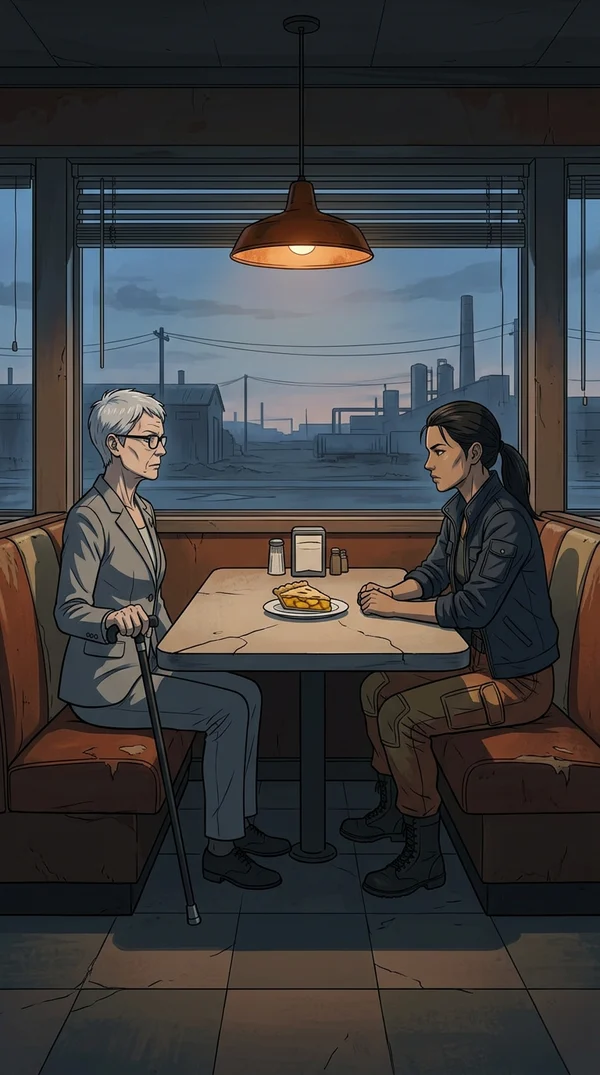
Hello, Tess. Lunch, Thursday, one o’clock, the Bluebird on Riverside. You’re paying. Leave anything sharp at home. V.

What did you think?