Highway 61, chapter 4 of The Lycan King's Human Mate
It was eleven below at six in the morning, the kind of cold that makes your nostrils stick together when you breathe in. I came down my stairs in the parka I’d bought for a ski weekend Brandon had cancelled, carrying one suitcase and my laptop bag and the blue binder, and the Suburban was idling at the curb in a cloud of its own exhaust.
Lucan got out of the back and took the suitcase from me. He didn’t say good morning. He looked at the parka, and then at my boots, and then at my face, the way I’d seen farmers look at a sky.
“Better,” he said.
“I own exactly one warm coat. This is it. If we go anywhere colder, I’m wearing you.”
Lindgren, behind the wheel, made a noise like a man swallowing a laugh in church.
We went up 35 in the dark. The city fell away behind us in a long orange smear, and then there was nothing for two hours but the highway and the snow coming at the headlights in long hypnotic streaks, and the black shapes of pine and birch going by on both sides like a crowd we were driving through. I’d thought I would work. I had the binder on my knees. I didn’t open it. I was too aware of the man beside me, of the exact width of the seat between us, of the fact that when the Suburban took a curve his knee came within an inch of mine and went away again.
The sky went gray around Hinckley. By the time we came over the hill into Duluth it was full light, a hard, clean, colorless light, and I said, “Oh,” out loud, because I’d never seen the lake in winter.
The whole city is built on the side of a hill that falls into Superior, and from the top of it you look out at a body of water that doesn’t look like a lake at all. It looks like the end of the world. The ice ran out from the shore in plates and ridges, white and blue-gray and heaved up in broken slabs along the harbor, and past it the open water was black, flat black, and smoking. Long ropes of white vapor lifted off the surface and leaned south in the wind, thousands of them, as far as I could see.
“Sea smoke,” Lucan said. “When the air is colder than the water.”
“It looks like it’s boiling.”
“It’s thirty-four degrees.” He was watching me, not the lake. “It always looks like that from the hill. People drive up from the Cities to see it and then they go home and tell nobody believes them.”
We went through Duluth and out the other side, past Two Harbors, and the road began to cling to the shore. Basalt cliffs, black and streaked with frozen seep, ice hanging off them in great pale blue curtains. Spruce and fir and the white of birch. The lake on our right the whole time, there and then gone behind trees, and then there again, enormous.
At Silver Creek the road went into the rock. A tunnel, long and lit, and then we came out of it and Lucan said, “There,” and pointed through my window at a ledge on the cliff face outside, a narrow shelf with a guardrail along it, high over the water.
“The old road,” he said. “Before they blasted the tunnel. It went around the edge. In winter you drove it at ten miles an hour and prayed.”
“Did you?”
“I don’t pray.” He looked at the ledge until it was gone. “I drove it.”
I asked him about it somewhere past Split Rock. I’d been working up to it the way you work up to the money question in a divorce, the one everyone’s been circling.
“What happens if I say no?”
He didn’t pretend not to understand.
“Then you say no.”
“And you?”
“I live with it.”
“With the knowing.”
“It doesn’t stop.” He said this to the window. “It’s not meant to. The old ones say a wolf who’s refused carries it until he dies, and goes on being decent anyway, or doesn’t. That’s the test.” A pause. “I’d like to think I’d pass.”
I looked at his profile. The heavy line of the jaw, the gray at the temple, the stillness. I thought about Brandon, who had needed me to clap.
“Has a human ever said yes?”
He was quiet so long I thought he wouldn’t answer. Lindgren’s eyes came up to the mirror and went down again.
“Once,” Lucan said. “Not in living memory.”
“Except yours.”
“Except mine.” He turned his head and looked at me. “My brother was king before me. Mathieu. He was the one who came west, a long time before the treaty, when this was still fur country. In 1791 he knew a woman at the trading post at the mouth of the St. Croix. Hélène. A trader’s daughter. She had a laugh you could hear across the river, and she read every book that came up it, and she was entirely human.” He looked down at his hands. “She answered him. They had a son. There were wolves then who said a human queen would bring the hunters down on all of us. They called themselves Old Blood. Some still do.”
“What happened?”
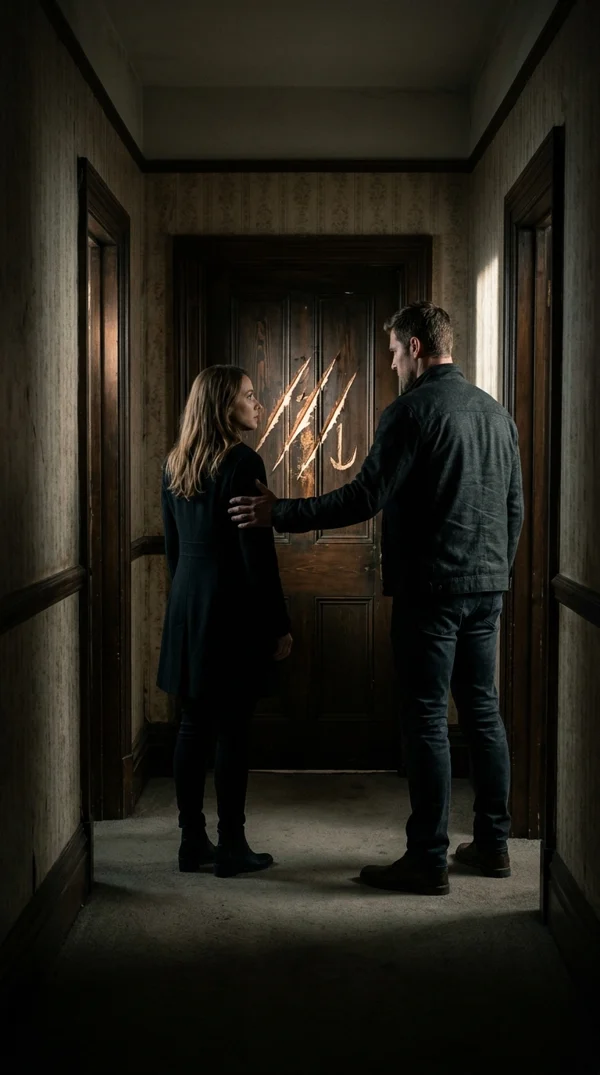
“They came in the winter of ’94, while he was away. They cut a mark in her door first, so she’d know.” His voice didn’t change. That was what got me. “He walked into the lake the next spring. I was king by the time the ice went out.”
The road climbed and fell. The lake smoked. I didn’t say I’m sorry, because I’ve watched people say it to me across a table and it’s always the wrong size.
“So when Adrian talks about long memories,” I said.
“Adrian is Mathieu’s great-great-grandson. Hélène’s too.” Lucan’s mouth did the thing that wasn’t a smile. “He’s never seen the irony.”
It was dark by quarter to five. We passed Lutsen and the lit-up ski hills, and then the road went quiet, and ten miles on Lindgren turned off it onto a narrow drive that went down through spruce so thick the headlights made a tunnel of them. And then the trees opened and there was the house.
Skarvik. It sat on a point of black rock that ran out into the lake like a fist, and it was stone at the bottom and timber above, long and low, with deep eaves heavy with snow and every window lit gold. Below it, the lake had built ice on the rocks in shapes I didn’t have words for, glassy and rounded and layered like candle wax, glowing faintly blue in the light from the windows. Past that, the open water, and the sound of it: a deep hollow boom and hiss, again and again, like something very large breathing in its sleep.
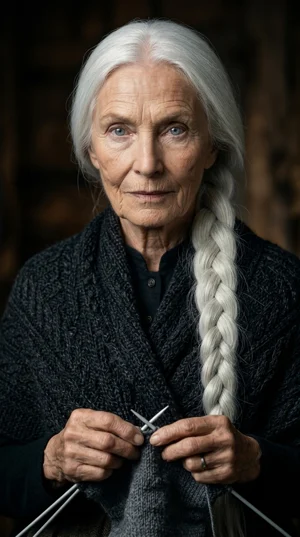
A woman stood in the open doorway with knitting in her hands.
She was tiny and straight-backed, with white hair in a braid down to her waist, and she was wearing house slippers in the snow. She watched me get out of the Suburban with the expression of a person evaluating a casserole someone else had brought.
“So,” she said. “This is her.”
“Avery,” Lucan said, “this is Solveig. She runs the house.”
“I run the house,” Solveig agreed. “He thinks he runs the river.” She looked at my parka. “That’s not a coat. Come in before your face falls off.”
Inside it smelled of woodsmoke and cardamom and wet wool drying. There was a fire in a stone hearth you could have parked a car in. There were books everywhere, on shelves, on tables, stacked on the stairs, and a long table under the windows with a lamp at one end, and from every window, the black lake.
Solveig showed me to my room herself. Down a hall on the far side of the house from the big stair, a long way from anyone. It was plain and warm and had a window onto the water and a wool blanket on the bed in red and black stripes.
The key was in the lock. On the inside.
I stood and looked at it.
“He had me put a new one in this morning,” Solveig said behind me, “after he called. Old one turned from both sides.” She clicked her needles. “He said you’d want to see it was new.”
I didn’t say anything. I went into the bathroom to have a second alone, and on the sink, in a glass, there was a toothbrush. New. Still in its packaging, a plain blue one from the drugstore, the cardboard backing sticking up out of the glass.
I don’t know why that was the thing. I’d been claimed in front of eleven werewolves and driven two hundred and fifty miles to a castle on a rock, and I’d handled all of it, I’d been fine, I’d been making jokes. And I stood in a strange bathroom looking at a two-dollar toothbrush that someone had thought to buy for me, and put out for me, and left in its packet so I’d know it was mine and nobody else’s, and I had to sit down on the edge of the tub.
I’d been moved out of a life in a sandwich bag. Somebody had made room for me in a glass.
I couldn’t sleep.
I lay under the striped blanket and listened to the lake booming against the rocks, and I knew where he was. I’d known all evening, through dinner with Solveig, through the hour I’d spent pretending to read the binder by the fire while he sat across the room with a book he wasn’t reading either. He was a warmth at the edge of everything. When he’d gone upstairs I’d felt it rise through the house and settle somewhere above me and to the left.
At a little after one, it went out.
I sat up. It was like a furnace cutting off. The house was exactly as quiet as it had been, the lake exactly as loud, and he wasn’t in it anymore.
I got up and put on my boots and the useless parka over my pajamas and went down the long hall, and found the door to the terrace, and let myself out into a cold so total it felt like being slapped. The moon was most of the way to full. The snow on the terrace squeaked under my boots. Below me, the ice on the rocks shone blue-white, and past it the black water moved, and on the ice shelf at the edge of the point, where the shore ice met the open lake, something was standing.
A wolf.
It was black, with silver through the ruff and down the back like frost on a dark coat, and it was too big. I’ve seen wolves at the zoo. I know what size they are. This was the size of a pony, and it stood at the very edge of the ice with the sea smoke curling around its legs, looking out at the water, perfectly still.
I didn’t make a sound. I’m sure of that.
It turned its head anyway, and looked up at me on the terrace, and its eyes in the moonlight were the palest gray I’ve ever seen. The lake in January.
What did you think?