The Answer, chapter 5 of The Lycan King's Human Mate
He was at the stove when I came down, in a gray sweater with the sleeves pushed up, frying potatoes in a cast-iron pan the size of a hubcap. Human. Entirely, ordinarily human, with a dish towel over one shoulder.
“Coffee’s there,” he said.
I poured some. I stood by the window with it and looked at the ice shelf at the end of the point, where the smoke was still curling off the open water in the morning light, and where there were, if you knew to look, tracks.
He didn’t mention it. He turned the potatoes.
I lasted about four minutes.
“You looked at me,” I said.
The spatula paused.
“Last night. On the ice. You turned around and looked at me, and I hadn’t made a sound.”
“You didn’t need to.” He set the spatula down and turned around, and leaned back against the counter with his arms folded, and gave me his whole attention, which is a thing I was going to have to learn to survive. “I always know where you are. It’s the same for you. Isn’t it.”
It wasn’t a question, so I didn’t answer it.
“It’s not supposed to be,” he said. “Not for a human.”
“Well,” I said, “I’ve always been an overachiever.”
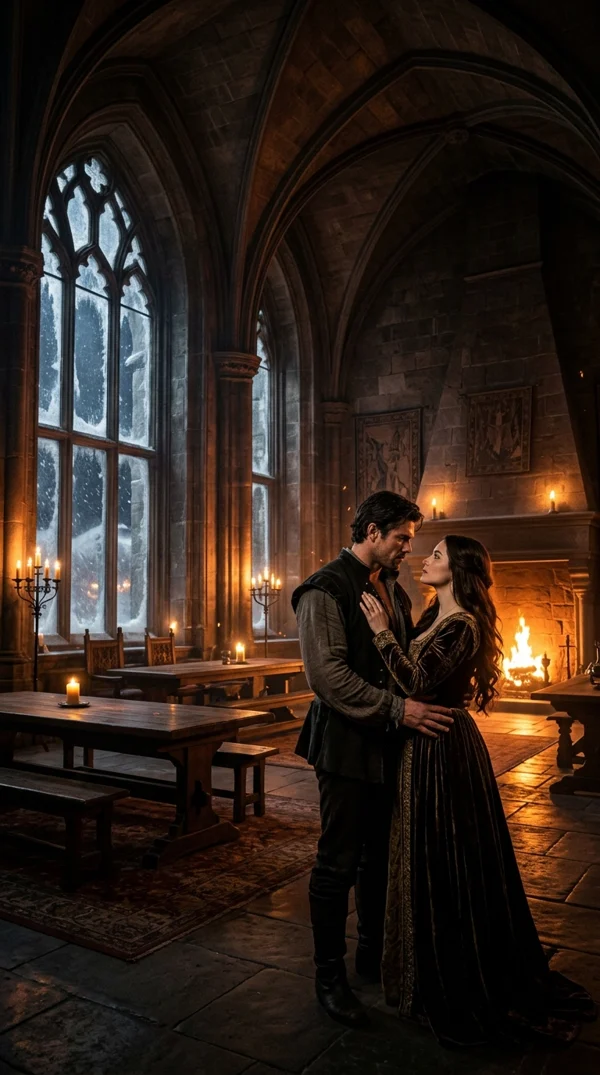
Solveig explained it to me properly at the long table under the windows, mid-morning, while Lucan was outside with Lindgren doing something to a snowmobile that involved a great deal of swearing in Norwegian. She knitted while she talked. She was making a sock, gray wool, on four tiny needles, and she never once looked down at it.
“The knowing is his,” she said. “Like a dog knows its home. It pulls. You feel it now too, which nobody has heard of, and I’m a hundred and four, so I’d have heard. Fine. It pulls.” Click, click. “It does not decide. That’s the part the young ones get wrong. The answer is yours. You say it once. Out loud. You say it because you want to, nobody making you, not him, not the moon, not the pull. And then it’s sealed.”
“And if someone forces it?”
She stopped knitting. It was the only time I saw her stop.
“It’s been tried,” she said. “In the old country. A wolf who wanted a woman who didn’t want him, and his Alpha who made her say the words.” She started again. “It dies. The bond. Like a fire you light in the rain. It dies, and something in him dies with it, and the old women say that’s how it should be.”
I sat with that. Outside, the snowmobile coughed and caught and Lindgren whooped.
“He’s never brought anybody here,” Solveig said. “You should know that. Sixty years I’ve kept this house. Not one.” She held up the sock, examined the heel, and went on. “He used to sit in that chair by the fire all winter and read and not talk to anybody. I thought he’d die of it. Lycans don’t, but I thought he might try.” Click. “He talks to you.”
“He barely talks at all.”
“Boy,” Solveig said, “that’s him talking.”
Margaux Duval arrived after lunch in a Volvo with Pepin plates and a man’s barn coat over her cashmere, staying on for the seal on Sunday like everyone else from the treaty who mattered. She shook snow off her boots in the doorway and looked around the great room, at the books and the fire and the windows, and then at me.
“So it’s true,” she said. “He brought you home.”
“I’m a guest.”
“Mm.” She took out a clove cigarette and didn’t light it. “My father’s coming Saturday. Edith Corbin too, God help us. Half the river will be here by the moon.” She jerked her chin at the terrace. “Come outside. I need to not smoke at you.”
It was twenty below on the terrace. My eyelashes froze. Margaux wore her coat open and didn’t feel it at all. Wolves ran hot, I was learning, and I resented every degree of it.
She didn’t make me ask. That’s a thing I like in a party. She told me about it like reading a list of charges. Twenty-three, an apartment in Red Wing, a job at the clinic, and a woman. Mae Okerlund, a nurse, human, night shifts in the emergency room, who’d been with her three years when her father came to the kitchen door with his hat in his hands. The wedding a month later. Eleven years beside Torvald, who was kind and patient and whom she had never once been able to talk to about anything that mattered.
“Mae still sends me a photo of the river,” she said. “Every morning, when she comes off nights. Eleven years. I’ve never answered one. If I answered, I’d get in the car.” She turned the cigarette in her fingers. “So you understand why I’m in a hurry for Sunday.”
“I do.”
“Then understand this too.” She looked at me sideways. “Adrian Marrok has been in my father’s house twice since Friday, and in Edith’s. Very concerned. Very gentle. Saying it’s not his place to criticize his uncle, of course, but a human queen, in times like these, with phones and cameras, it brings hunters. It always has.” She tapped the cigarette on the rail. “And there are people listening. Old wolves, mostly. Up on the Range, down by the Iowa line. They don’t come to gatherings. They come to other things.”
“The Old Blood.”
“Nobody says it out loud anymore. That’s how you know they’re still around.” She put the cigarette away. “I’m telling you because nobody told Josette anything, and I’m her great-great-granddaughter, and I’m tired of it.”
I spent the rest of the afternoon at the long table with the treaty file spread out in front of me, building the inventory of the dower lands I’d need on Sunday. Every parcel the 1826 treaty had set aside for the two packs to hold in common: the river frontage at the Falls, the Pepin bluffs, the timber and hunting grounds on the Shore. Every parcel had to be accounted for before the king’s seal went on the division. That’s not law. That’s me. I don’t let parties sign for things nobody’s counted.
Lucan came in from the cold around three, smelling of gasoline and snow, and sat down at the other end of the table with a book, and didn’t speak.
It should have been distracting. It wasn’t, exactly. It was like working in a room with a fire in it. I’d look up from a plat map with my eyes aching and he’d be there, turning a page, and I’d look down again and the numbers would make sense.
At four, without a word, he put a mug of coffee next to my elbow.
Black, with a splash of milk. Not hot. He’d let it sit until it was the temperature I actually drink it, which is lukewarm, which is disgusting, which I’ve been told by every man I’ve ever dated, and which I had never once mentioned to him.
I looked at it. I looked at him. He’d gone back to his book.
“How did you know?”
“You let your coffee go cold on Monday. Three times. You drank it each time it got cold, not before.” He turned a page. “I notice what you do.”
I picked up the mug. My hands weren’t entirely steady.
Brandon had dated me for two years and made my coffee twice, scalding, with sugar in it, because that was how he took his.
The sun went down at quarter to five in a long violet bruise over the Sawtooth hills, and I went out on the terrace to watch it go because I couldn’t stay in the room with him anymore. I could hear the lake. I could feel the cold coming up off the ice in a wall.
The door opened behind me and closed. I didn’t turn around.
He came and stood beside me at the rail. Not touching. He was never touching.
“Your ears have gone white,” he said.
“Solveig says I’ll lose a finger.”
“She’s usually right about fingers.”
I turned around then and looked at him. The last light was on his face, on the gray at his temple, in those eyes. He was so still. He was always so still around me, like a man holding something very full that he was afraid to spill.
I thought about the lock with the key on my side. The toothbrush in its packet. The coffee gone exactly cold. All the things he’d done that weren’t asking for anything.
I took hold of the front of his coat in both fists and kissed him.
For one second he didn’t move at all. I felt it: the shock going through him, all that size and heat held absolutely still under my hands, the way you’d hold still for a bird that had landed on you. Then his hand came up, slow, and cupped the back of my head, and he kissed me back, and it wasn’t careful anymore.
I’ve been kissed. I’m thirty. I’d been kissed by a man for two years who kissed the way he wrote emails, correctly and with an eye on the clock. This was not that. This was being kissed by someone who had waited for it for a very long time and had decided, somewhere around my second breath, that he was done waiting. His mouth was hot in the cold, and he tasted of coffee and snow, and his stubble scraped my chin raw and I didn’t want him to stop doing it. He made a sound low in his chest that I felt more than heard. I let go of his coat and put my hands inside it, flat against the heat of him through the sweater, and he backed me against the stone rail and the cold of it went through my parka and I didn’t care. I didn’t care about anything. I had my fingers in the wool at his waist and his hand spread wide at the small of my back, pulling me in, and I wanted, I wanted, I wanted so badly it scared me.
I was the one who stopped.
I pulled back an inch. Then another. I was shaking. He let me go the instant I moved, his hands opening, and stood there breathing hard with the sea smoke rising white behind him, looking at me like I’d struck him and handed him a gift in the same motion.
“I’m sorry,” I said. “I can’t, I’m not. Not yet.”
“Don’t be sorry.” His voice was rough. “Never be sorry for that.”
The terrace door banged open.
Lindgren stood in it. He was holding a flashlight, and he wasn’t calling me ma’am, and his face had gone a color I hadn’t seen on it.
“Boss,” he said. “You need to see her door.”
It was the door to my room, at the end of the long hall on the far side of the house. Somebody had come up over the rocks from the ice while we stood outside, and in through the boot room, and down that hall, and gone again. They hadn’t tried the lock.
They’d cut a mark into the wood instead, at eye height, deep and clean: three slashes and a hook, raw and pale against the dark old pine.
Solveig, behind us, made a sound I will never forget.
“That’s the one,” she said. “My grandmother drew it for me when I was small, so I’d know it. That’s what they cut in Hélène’s door.”
What did you think?