At dawn I let the lehr down.
It’s a small thing, done right. You open the damper a finger’s width, and you wait, and you put your palm flat to the iron door and feel the heat go out of it the way you’d feel a fever break in a child’s forehead. A finger’s width, no more. The heart inside is still dull red at the middle. If I hurry it, it’ll crack. If I leave it, it’ll set wrong. Nobody else touches this damper while I’m in Sunmere; I told Wilf on the first day I’d break his fingers, and he believed me, because I meant it.
I haven’t slept. My mouth still feels like his.
When the iron’s right under my hand, I go and find Dervla.
She’s in the lamp room, a long cold cellar under the kitchens where the court’s spare lampglass sits on racks in rows like eggs in a shop. She’s got a cracked lamp on the bench in front of her and a pair of thick leather gloves on, and she’s coaxing the last of its fire into a new globe with a pair of tongs, slow and steady, the way you’d pour milk for a cat.
“Tell me about his mother,” I say.
Dervla doesn’t look up. The fire goes into the new glass in a thin gold thread.
“Who’s been talking about his mother?”
“Lord Cathal. Last night. At the bottom of the terrace steps.”
“Was he.” Dervla sets the new lamp in the rack. She strips off her gloves, finger by finger, and lays them on the bench. “Come on, then.”
The long gallery runs the whole length of the west wing, with windows down one side and the High Lords of Summer and their mates down the other, in gilt frames, going back further than paint ought to last. Dervla walks past most of them. She stops near the end.
“Lady Eithne,” she says. “Of the Spring court. His mother.”
She’s small, for a fae. Pale-haired, with a pointed, laughing face and a sprig of white blossom tucked behind one ear, and she’s painted standing in sunlight. All of her is lit. The painter has done it so well that the light seems to come out of her rather than fall on her. She looks about my age, and happier than anyone I’ve ever met.
“She was bonded to the old High Lord at Midsummer,” says Dervla, “under the old Sunglass. The light flared, and they both said I take it, and his fire went into her. That’s the bond, in Summer. Half the lord’s fire goes into the one he takes. All at once, there in the light. It’s meant to be the most beautiful thing you’ll ever see.” She looks at the painting. “It was. I was there. She shone like a lamp.”
“And then?”
“And then she went on shining.” Dervla’s voice doesn’t change. “Fevers, at first. Her hands too hot to hold a cup. She scorched her sheets in her sleep. She laughed about it. She laughed about everything. She had the boy, and she carried him around on her hip with a wet cloth over her shoulder so she wouldn’t burn him. Ten years. Every year a little brighter.”
I don’t want to hear the rest. I stand there and hear it anyway.
“One morning,” says Dervla, “she was sitting by the window in her room with her sewing. And she just went. Like a lamp with too much oil. There was no reason. Nobody was near her.” She pauses. “He was standing in the doorway. Forty winters. That’s twelve, to you.”
I look at the laughing face in the frame.
I’ve seen glass do exactly that. Sit on a shelf for years, perfect, holding something in. And then one morning, with nobody near it, break.
The thought is clear and cold and I don’t know what to do with it yet, so I put it away, the way you put a strange-coloured cullet in a separate tin until you know what it’ll do in the pot.
“His grandmother went the same way,” says Dervla. “Slower. And hers before that, they say. The court calls it the Summer curse, when it’s sure he isn’t listening. Every mate a High Lord of Summer has taken, burned.” She looks at me sidelong. “He has walked the light alone every Midsummer since he was crowned. Two hundred and forty of them. First, by himself, and out again with nothing. He’s three hundred and four. He’d stopped expecting anything. You could see it. Then a mortal girl with sand in her hair came up from the coast to build him a new lens.”
“Don’t,” I say.
“I’m only telling you what happened.”
“I know what happened. I was there.”
Dervla looks at me a while longer. Then she nods once, at something I haven’t said, and jingles off down the gallery and leaves me with Lady Eithne, shining.
I still have his glove.
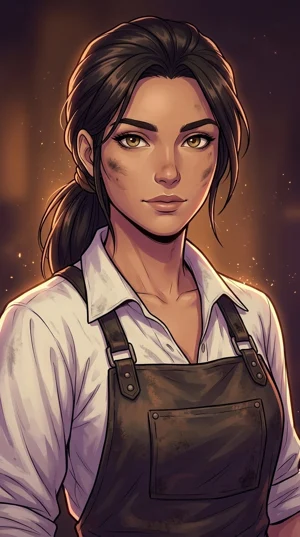
It’s in my apron pocket, where it’s been since the night the broom caught. I’ve been meaning to give it back. I’ve been meaning to give it back in a way that makes it clear I don’t care whether he has gloves or not, and I haven’t worked out how to do that yet, so I’ve been carrying it around like a dead bird.

 100 to start reading with.
What did you think?