I spend the day not thinking about it.
I let the lehr down at dawn and again at noon, a finger’s width each time. I eat bread standing up. I show Wilf how to set the grinding bed for the heart and go over his chalk lines twice, and he lets me, though he can see as well as I can that they were straight the first time. At supper I sit at the far end of the hall and say thank you to the footman instead of anything else, and nothing on the high table breaks, and I feel the whole court notice.
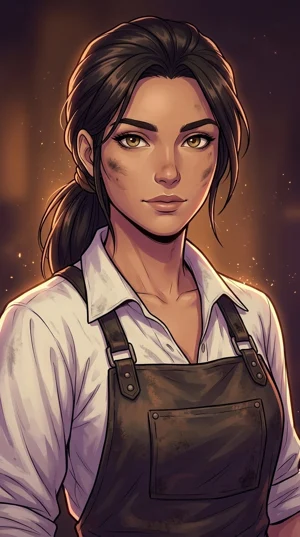
When the bells go, I don’t change. I go up in my work shirt and my leather apron, with sand on my boots. I’m not dressing for him. I’m going to ask a question and hear an answer, the way you’d go and look at a crack.
The roof of the east tower is lead, laid in long grey sheets with rolled seams, and at night it gives back the day’s heat. He’s sitting with his back against the chimney stack, in his shirt, with his knees drawn up and his gloved hands hanging between them.
He doesn’t get up when I come out of the little door. He just looks at me.
I don’t sit. I walk to the parapet and look out, because it’s easier than looking at him.
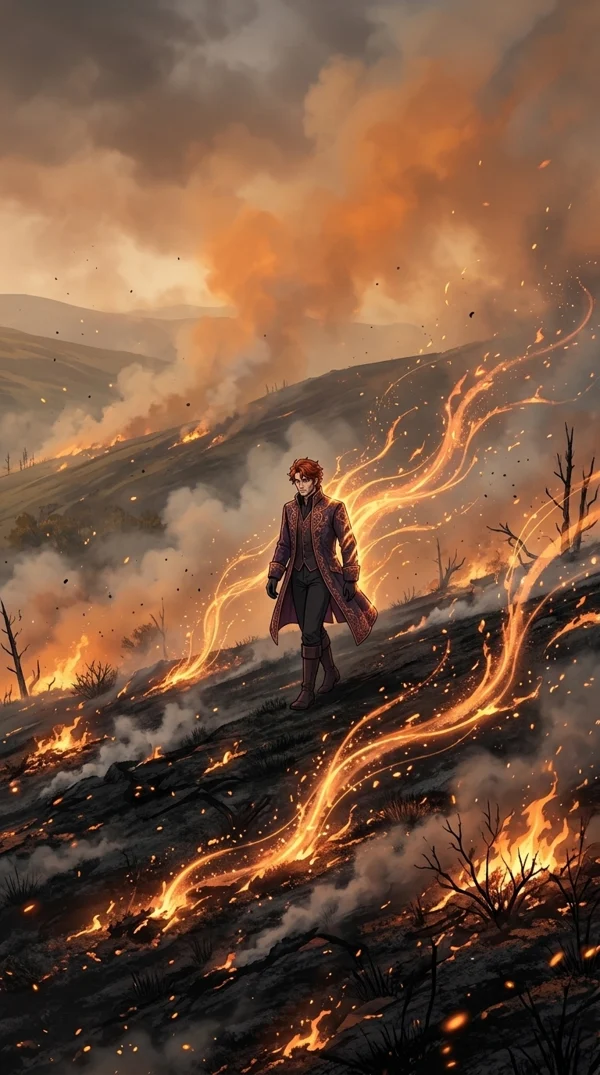
From up here you can see all of Summer that matters. The lake, low and silver under the moon, with its pale rim of dried weed. The town. The road to the Sunsands, white in the dark. And all around, as far as the hills, the fields: wheat that should be green to the knee at this time of year, standing brown and stiff and still, like something painted on a plate. Far off along the ridge to the north there’s a faint red line I take for a sunset, until I remember which way north is.
“The hills are burning,” I say.
“Yes.”
“Is anyone putting it out?”
“I will,” he says. “Tomorrow, or the day after. It isn’t near the farms yet.”
I don’t know what that means, and I didn’t come up here to ask it. I hold onto the parapet. The stone is warm.
“You said anything.”
“I did.”
“Did you know?” I turn round. “Before the light. That spring. Did you know what I was?”
“Yes.”
Just that. No pause.
“Since when?”
“The third night.” He’s looking at his hands. “In the workshop. You’d burned your thumb on the punty and you put it in your mouth and swore at it, and called it a name I’d never heard, and I knew. Summer feels it before the light shows it. Like hearing a bell before you see the tower.”
The third night. I’d known him three days. I’d thought he was a bored lord who liked watching things get made.
“That’s why you asked me to call you by your name.”
“Yes.”
“Dervla says only your blood and your mate say it.”
“I wanted to hear it once.” His voice is very even, as if he’s carrying something full to the brim and can’t let it slop. “Before I had to give it up.”
Something in my chest goes hot and then very cold.
“So you knew,” I say. “You knew all spring, and you asked me to come and stand in your hall at Midsummer, and you let the light find me in front of five hundred people.”
“No.” He looks up then. “I asked you to see your lens work. From the gallery. I’d kept you a place there, at the rail, away from the floor. I didn’t think the light would reach the gallery.” His mouth twists. “I’d never seen it leave the dais. Nobody had.”
“The gallery was full,” I say slowly. “When I got there. There were people in my place. Somebody said there was room at the back of the hall.”
Something goes out of his face.
“Who?” he says.
“I don’t know. A footman. It doesn’t matter.” It matters. I can see on his face that it matters, and I put that away too, in the separate tin, with the laughing woman in the frame. “So the light came down to the floor. And it found me. And you walked down the whole hall to me, and you looked at me like…” I can’t finish that. “And you refused it. Why?”
He’s quiet for so long I think he’s going to stop there, with his mouth shut on the answer.
Then he says, “My mother sewed.”
I wait.
“She was terrible at it. She stabbed herself all the time, and laughed, and sucked her fingers the way you did. She was making me a shirt. She’d been making it for a year. Her hands got too hot to hold the needle for long, so she did a few stitches at a time with a wet cloth wrapped round her fingers, and put it down, and picked it up again.” He’s looking past me at the burning ridge. “I used to sit on the floor by her chair while she did it. She’d put her hand on my head, through the cloth. It was like having a hot stone on your hair. I liked it.”
The lead under my boots is warm. I can feel it through the soles.
“That morning I’d gone out to the stables and come back up to show her something. A bird’s nest. I was in the doorway. She was in the window with the shirt, and the sun on her, and she looked up at me and said, ‘Oh,’ as if she’d dropped a stitch.”

 100 to start reading with.
What did you think?