We ride.
I don’t remember most of it, and what I remember comes in pieces, like cullet. The coast road at a gallop with the sea on our right. Inn yards in the dark, and grooms holding lanterns, and fresh horses, and Wilf paying with the guild’s credit in a voice that gets hoarser every time. The ferry over the Tamble, where the ferryman takes one look at the High Lord of Summer and pushes off without asking for a penny. Wilf asleep in the saddle, held on by the knees. My thighs on fire. Not stopping.
He rides ahead of me, and the grass at the edge of the road browns where his horse goes. Under his torn breeches his knees are bound in rag from my glasshouse, and the rag is brown by the first inn. He doesn’t mention them once.
By evening his horses won’t let him near them. The third inn’s grey throws its head and screams when he puts his hand on the bridle, and he has to stand back while I lead it. His gloves are smoking. When he gets up into the saddle the leather creaks like something on a griddle.
“You can’t go on like this,” I say.
“I can go on like this until noon tomorrow,” he says. “That’s the arrangement.”
At the next village there’s a smithy. It’s past midnight, and I hammer on the smith’s door until he comes down in his nightshirt with a poker, and then I tell him who I am and who’s standing behind me in his yard with his hands on fire, and he opens up the forge without a word and goes back to bed.
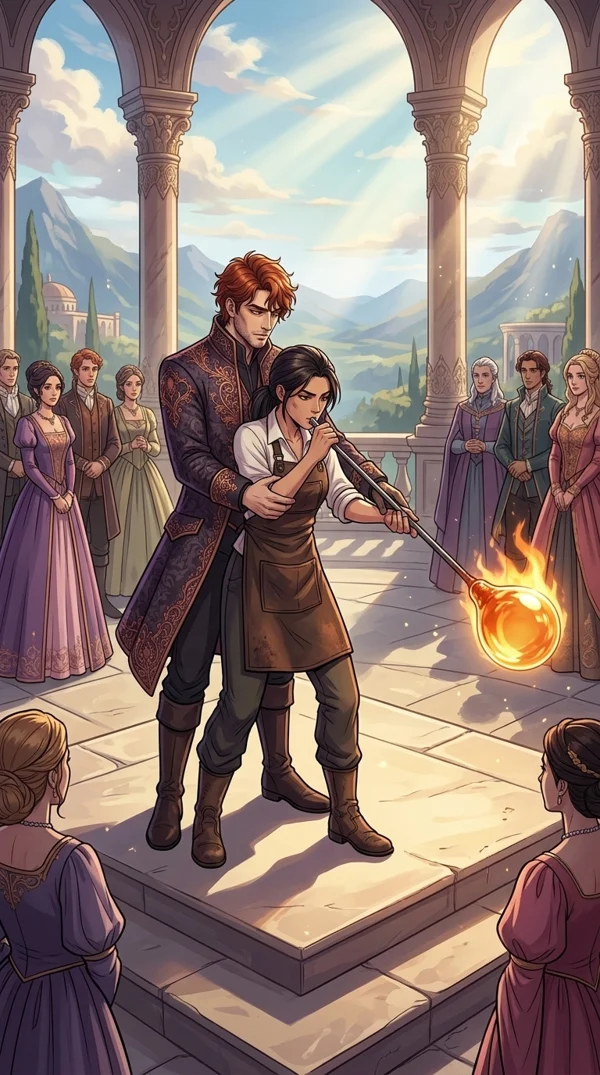
It’s the wrong fire for glass. A forge is too hot in the middle and cold everywhere else. I make it work. I melt a handful of my good Gullmouth cullet in the smith’s iron ladle, and gather it on my pipe as best I can, and say, “Your hand,” and he holds it over the gather, bare.
The glass drinks. I blow.
It’s the ugliest lamp ever made on the Glass Coast. It’s lopsided and full of seed and it’ll probably crack by Tuesday, and it glows like a harvest moon. He sits down on the smith’s anvil block, and looks at his hand, and flexes it.
“A candle,” he says. “Out of a forest.”
“It’s enough to hold reins.”
He flexes the hand again, and for a while neither of us says anything.
“I saw the lamps go out,” I say. “From the rise, when the carriage left. Every one.”
“That was me.” He doesn’t look up. “When the carriage went over the hill, everything in me went after it. Every flame I’ve ever put in glass leaned after you at once and came home to me, and I spent the morning trying to hold it there.” He turns his cooled hand over. “Dervla lit the hall with tallow. I lasted until noon.”
Then, before I put the pipes away, I do the other thing I’ve been planning since Gullmouth. I take my best pipe, the long one with the worn mouthpiece that was my mother’s, and I gather a knob of the clear Gullmouth glass onto the end of it, a fist’s worth, and marver it round, and I don’t blow it. I let it go cold on the iron, slowly, buried in the smith’s warm ash, the best I can do for a lehr.
A cold gather. A knob of glass on the end of a pipe, waiting.
“What’s that for?” he says.
“Noon.”
He looks at it for a long time. He doesn’t ask anything else. That’s how I know he means what he said on my floor.
He sleeps for an hour against my shoulder, sitting up against the forge wall with his head down, and I don’t. I listen to his breathing and count it like a heat, and at the end of the hour I wake him, and we ride.
We come over the last hill into Sunmere in the middle of Midsummer morning, and the gates are shut.
There are guards on them. Summer green, twenty at least, with long spears. The dune road beyond is shut too: I can see the chain across it from here, and the free cities’ carts that have already come up to it, empty, waiting, with their drivers sitting on the tailboards.
Lord Cathal is on the gatehouse steps.
He’s in white and gold for the Walking. He looks rested.
“Cousin,” he says, as we pull up. “You’re late for your own Midsummer.”
The High Lord doesn’t answer. He sits his horse, swaying, with his gloves smoking in the reins.
“The council met,” says Cathal pleasantly, “in your absence. A High Lord who leaves his court three days before Midsummer to chase a mortal down the coast road can hardly be said to have been in his right mind when he set his seal. The council agreed. The Compact is void.” He smiles at me. “The dunes are shut, Mistress Glass. I’m so sorry.”
Wilf makes a noise. I put my hand on his arm.
“But the Walking can’t wait, of course,” Cathal goes on. “The High Lord walks first. It’s the law. The court is assembled.” He stands aside from the gate, and it opens. “The light is waiting for you, cousin.”
He wants him in it. He wants him standing under my lens at noon, in front of all of them.
“Not her,” says Cathal, as I touch my heels to my horse. Two of the guards step into my way. “The mortal who bewitched the High Lord out of his own court at Midsummer is not welcome in his hall. I think the council would agree.”
The air goes strange.
It bends all round the High Lord, the way it bent in the arcade on the first night, but worse, far worse, the whole gateway wavering like a road in August. The guards’ spear-hafts begin to smoke in their hands. One of them drops his spear and it bursts into flame on the cobbles. The horses scream.
“Don’t,” I say.
He looks round at me. His eyes are gold all through, like the lamp.
“Don’t,” I say again. “Save it. You’ll need it.” I make my voice cool and steady, my envoy voice, the one that’s got me through every door in this place. “Go and walk your light, my lord. I’ll be there.”
It’s the hardest thing I’ve ever asked anyone to do. I know that. I watch him know it.
He looks at me for one breath longer. Then the air stops bending.
“Yes,” he says.
He rides in through the gate without me, and doesn’t look back. That’s the promise, kept. It looks exactly like trust, because it is.

 100 to start reading with.
What did you think?