“I take it,” I say.
My voice comes out clear. It goes up into the dome and comes back down, the way his laugh did once, and the whole court hears it, and I don’t care about any of them.
He closes his eyes.
“I take it,” he says.
The fire comes.
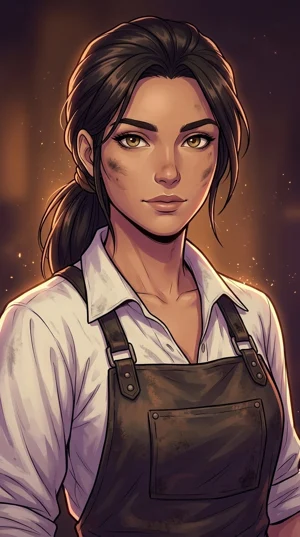
I’ve stood at the mouth of a furnace every working day since I was nine. I know what it’s like when you open the door on a full pot and the heat comes out at you and shoves.
This is that, if the furnace were the sun.
It comes down the gold thread between us all at once, the whole banked weight of Summer, three years of it, and I know in the first heartbeat that if I let it into me like this it will do what it did to the laughing woman in the frame. It won’t wait ten years. It’ll do it now.
So I don’t let it into me. Not first.
I pull my mother’s pipe out of my belt and lift it, and put the cold knob of Gullmouth glass on its end into the very centre of the column, into the bright point where all the light from my lens comes down to meet, the place where once I held a rod and watched it melt in four breaths.
You’ve made the sun into a furnace, he said.
I have. I built it.
One breath. The glass goes dull red. Two. Orange. Three, and it’s soft, and sagging, and I’m turning the pipe, turning, never stopping, the way you have to or it falls. Four, and it’s molten, a gather, alive on the iron.
And the fire goes into it.
It turns away from me and pours into the glass instead, as it poured into the lamp in the workshop and the ugly lamp in the smithy. The gather drinks. It goes gold and then brighter than gold, so bright I can see the bones of my hands through it, and it gets heavy, too heavy, it’s swelling and slumping on the end of the iron, too full, and my arms are shaking and the pipe is starting to tip and I can’t turn it and hold it at the same time, not with this much, not alone.
His hands close over mine on the iron.
Bare. Burning. The way I put mine over his, the first time, at the bench, to show him how to turn.
He doesn’t take it from me. He doesn’t steer. He just holds on, his hands over my hands, and turns when I turn.
I put the mouthpiece to my lips.
“Breathe slow,” I say.
To him. To me. To the glass.
We breathe.
I blow into the pipe the way my mother taught me, slow and even, and the gather opens. A bubble swells in it, full of fire, and as it swells the fire comes back up the iron, not all at once now, but at the pace of my breath, through the pipe and into my hands under his, into my wrists and my arms and my chest, warm, so warm, like stepping into the sun after a long winter. A breath’s worth. Then another. Then another. Letting it in a finger’s width at a time.
It hurts. I won’t say it doesn’t. It hurts the way your hands hurt when you come in from the cold and hold them to the stove. It hurts the way it’s supposed to.
It doesn’t break me.
I don’t know how long. The court says afterwards that it was the whole hour, from noon until the sun moved off the dais, and that nobody in that hall sat down or spoke or looked away the whole of it. I don’t remember the hour. I remember breathing. I remember his hands, and the iron, and his forehead coming down against mine at some point, and our breath going into the pipe together, in, out, slow, until I couldn’t tell any more which of us was blowing.
And then the light thins.
The sun’s gone over. The column on the dais goes from gold to pale to nothing, and the hall is just a hall again, full of ordinary afternoon, and on the end of my pipe there’s a lamp.
It’s round and clear and perfect, the size of a man’s head, without a seed or a ripple in it, and it’s full of a deep, steady gold, like honey with the sun behind it. Like every lamp in Sunmere put together.
I knock it off the pipe.
He catches it. Bare-handed.
It doesn’t break.
I’m alive.
I stand there on the dais with the empty pipe in my hands and take stock of myself like a piece just out of the lehr. My hands are warm, but not burned. My chest is warm. There’s a heat in me, low down and steady, like a furnace banked for the night, and I know it’s his, and I know it’s going to stay, and I know it isn’t going to break me. Not on a Tuesday. Not ever. It came in slow.
He’s standing in front of me with the lamp of his own fire held against his chest, and his coat is still smouldering at the hem, and his face is cool. Pale, the ordinary pale of a tired man, and cool. The flush has gone out of it. His eyes are his own colour.
I look at him. I’ve waited three years to look at him like this.
“Faolan,” I say.
It’s the first time. Out loud, in my head, anywhere. Three years, and that spring before it, and I’ve never once said it, and it comes out of me easy as breathing.
He goes down on his knees.
Right there in front of me on the dais, in front of the whole court, with the lamp in his arms, and he’s laughing, and it isn’t the startled breath through the nose and it isn’t the laugh from the workshop either, it’s something else, something that sounds like a man who has had a door opened in front of him, and he puts his forehead against my stomach and holds on.

 100 to start reading with.
What did you think?