Small Change, chapter 3 of The Secret She Wouldn't Spend
I stitch the heir to the Keystone Throne with grey knotting cord at four in the morning, because the only needle I own is for beading and the only thread strong enough is what I use for stock.
He sits on the closed toilet lid with his torn shirt off and his arm raised, and I kneel on the bath mat with a headlamp on, and neither of us says anything about how this looks. The cut runs along his ribs, three long lines where the quiet’s fingers dragged. The skin around it has the faint sheen I noticed on his hands, like the inside of a shell. Up close, the glamour is thinner. His hair isn’t dark grey. It’s the grey of slate when it rains, and there’s light in it.
“You’ve done this before,” he says, watching my hands.
“Nana’s knees. She fell a lot at the end.” I tie off a stitch. Square knot, then a surgeon’s throw, then pull. “Hold still.”
“I am holding still.”
“You’re doing a thing with your breathing.”
“It’s called breathing.”
“Do it less.”
He does it less. I can feel him watching my hands while I work. I’ve got good hands. It’s the one thing I’d put on a résumé if résumés were honest: steady, quick, can make an earring disappear. When I tie the last stitch and bite the cord off, I sit back on my heels and he looks down at the neat row of grey knots in his side.
“These are good knots,” he says, like it surprises him.
“I know.”
“Who taught you?”
“Someone who said there’s no knot you can’t undo if you’re honest about which way it went in.”
He’s quiet. Then he holds out his wrist with the tether on it. The thread glints. “Then undo this.”
So I try. I sit on the bath mat with his wrist in my lap and the headlamp shining on it, and I work at the knot with my thumbnail, with the needle, with my teeth once, which makes him make a noise. I’m honest. I think about which way it went in. It went in when I said until I do, you stay where I can see you, and every time I trace it back, it comes to the same place. My mouth. My words.
“It’s tied with my own word,” I say finally. “I can’t undo my own word.”
“No,” he says. “Most people can’t.”
The plan, decided at five a.m. over toast, is that I pay him as fast as possible in whatever I’ve got, and we see how far that goes. The knot wants something heavy. Fine. Maybe a lot of light things add up.
By eleven we’re in a booth at Dot’s on Smallman Street, which has chocolate-chip pancakes the size of hubcaps and a waitress named Bernadette who has called me hon since I was nine. Sallow sits across from me in the window light wearing my biggest sunglasses, which have rhinestones on them, because daylight does something to him. Out in the sun his edges go soft and grainy, like a bad photocopy of a handsome man. People keep glancing at him and then glancing again and then frowning like they’ve forgotten what they came in for.
He has the black notebook open beside his coffee, which he also doesn’t drink.
“Go,” he says.
I put my hand flat on the table so he can see the thread. “When I was twelve I peed in the fountain at Point State Park.”
The thread does nothing. He leans over, touches the knot on my wrist with one fingertip, and tilts his head like he’s listening to a seashell. Then he writes something down.
“What’d it weigh?”
“A dust mote.” He turns the notebook. In that gorgeous handwriting: Fountain. 1 mote.
“That’s fake.”
“The knot doesn’t lie. You do.”
“Okay. I hate cilantro. I tell Sol I love it. She puts it on everything for me special.”
Touch. Listen. Cilantro. 2 motes.
“I read the last page of every book first.”
1 mote. “That isn’t a secret. That’s a character flaw.”
“I’ve never seen Star Wars.”
He looks at me over the rhinestones. “I don’t know what that is, and I’m still disappointed.”
We go on like that. Bernadette brings the pancakes and refills my coffee and calls him hon too, and he looks so startled I almost choke. I pay in motes. The guy I lost my virginity to sang the whole of “Don’t Stop Believin’” afterward and I let him. I once keyed the car of a man who kicked his dog, and I’d do it again. I cried at the end of a car insurance commercial. Mote, mote, two motes, mote. The column in the notebook gets longer. The thread doesn’t get any lighter.
“How many motes in a secret?” I ask.
“Of the weight you owe?” He thinks. “If you paid one a second, you’d finish around the time the Monongahela freezes solid.”
“That’s never.”
“Yes.”
I push the pancake around. Somewhere I’ve gone from trying to win to just talking, and I don’t like that I didn’t notice it happen.
“Your turn,” I say.
“I don’t owe you anything.”
“I know. Tell me one anyway.”
He looks at me for a long time. Outside, a truck goes by loaded with Christmas trees, and the sun comes out from behind a cloud, and for a second I can see right through his hand to the Formica. Then it passes.
“I’m afraid of geese,” he says.
I stare at him.
“Canada geese,” he says, like a man reading his own charges. “They live on the rivers. Above the court. They know what we are, and they have no respect for it, and there are thousands of them.”
I laugh so hard that Bernadette comes back to check on me. He doesn’t laugh. But the corner of his mouth does the thing from last night, the thing that wants to be a smile and has been told not to, and I watch it the whole time I’m laughing, and something in my chest that is not a fishhook pulls a little.
When I’ve calmed down, I do the coin thing I do when I’m nervous. I’ve got a quarter. I walk it over my knuckles, back and forth, index to pinky and back. He watches it go.
“I call my grandmother’s phone,” I say.
I don’t decide to say it. It’s just out.
“She died three years ago. The number’s disconnected. You get the three tones and the lady saying it’s not in service. I call it when I can’t sleep. I let it play all the way through and then I call it again.” The quarter goes over my knuckles. Index. Middle. Ring. “I’ve never told anyone that.”
He doesn’t say anything. He reaches across, carefully, the way you’d touch a bruise on somebody else, and puts one fingertip on the knot on my wrist.
He keeps his finger there through two refills of my coffee. Then he picks up his silver pen and writes something, and he doesn’t turn the notebook around to show me.
“What’d it weigh?” I say.
“More,” he says, “than everything else this morning put together.” He closes the notebook. “It still isn’t the one.”
“I know.”
“I know you know.” He’s watching the quarter, not me. “That’s what interests me.”
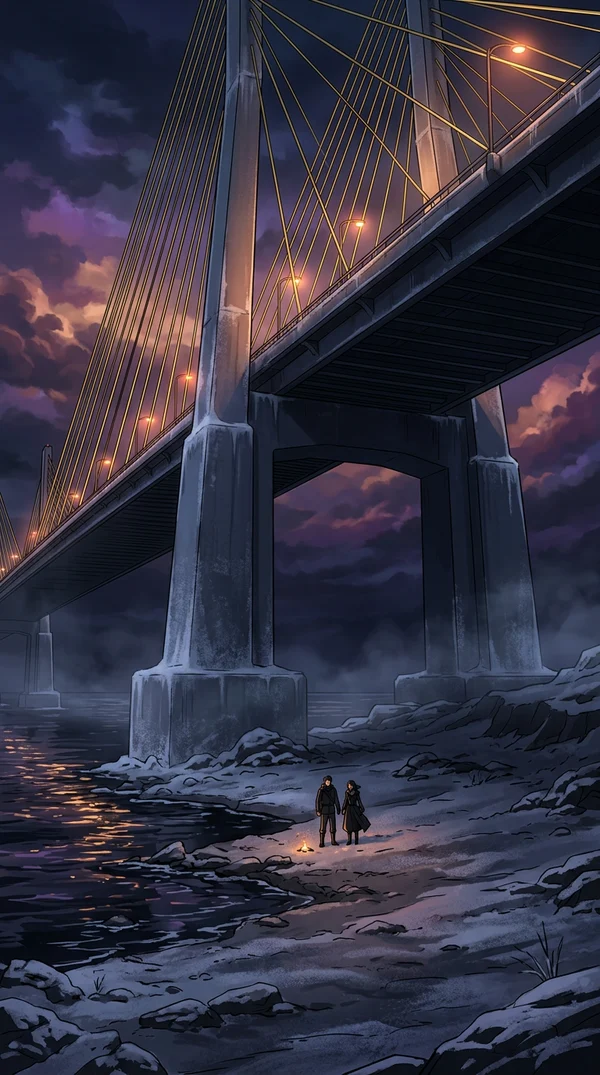
Dutch’s storage unit is in a row of orange doors behind a muffler shop in Millvale, on the far side of the Fortieth Street Bridge. I’ve been here maybe twenty times. You bang on the door, Dutch rolls it up, you pick through tubs of beads while he complains about the Penguins.
Today the door’s already up, and the unit’s empty.
Not cleaned out. Empty, like nothing was ever here. Bare concrete, no dust, no shelves, no Dutch. The air inside smells like a struck match. Sallow takes the sunglasses off in the shade of the doorway and his edges sharpen back up, and he walks into the middle of the unit and turns slowly, breathing in.
“Glamour,” he says. “A lot of it. Recently. Your wholesaler wasn’t a man.”
“He was a Pirates fan.”
“I’m sure he was very convincing.”
In the back corner, where Dutch used to keep the tub of evil eyes, there’s one cardboard box. It’s the same as the one he brought me last night. Inside are more grey knots, maybe twenty, and on top, tied to one of them with a strip of paper, is a tag.
It has a drawing on it in grey ink. A wedge-shaped stone, wider at the top than the bottom, with a small flame above it.
Sallow goes very still. While he’s staring at it, I take two of the knots out of the box and put them in my coat pocket. You always want to know your enemy’s stock.
“What?” I say.
“That’s mine.” He holds the tag between two fingers like it might bite. “The keystone and the lamp. It’s the heir’s mark. It’s on my door, my seal. Someone tagged this box for me.” He turns it over. On the back, in a different hand, just the end of a word, the rest torn off: …by order.
“Who’d do that?”
“Someone who wanted me to know exactly how little they’re afraid of me.” He puts the tag in his notebook. His voice has gone flat and careful. “Someone at court, with treasury silence for the quiet and a factor to run errands, who knew which debts I’d be sent to collect before I did.”
“And if you’re off the throne, who’s on it?”
“Nobody, for a while. A forfeited heir leaves the Keystone empty until the stone chooses again, and the Chancellor holds it as regent in the meantime. It’s taken the stone a century before now.” He almost smiles. “Oriel would hate it. He’d spend the whole century complaining about the paperwork.”
“Okay. Who sends you? To people like me.”
He’s quiet a moment too long.
“My mother,” he says. “The Treasury draws up the claims and the Queen signs every one.”
“You think your mother is trying to kill me to keep you off her throne?”
“I think,” he says, “that my mother has never once in my life done anything I could have predicted, and I’ve stopped assuming she likes me.”
Behind us, in the open doorway, someone coughs.
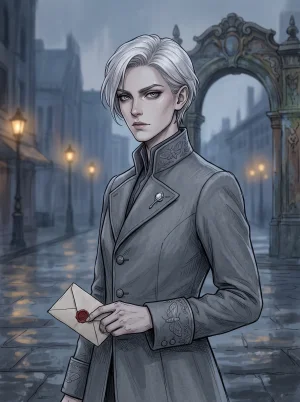
It’s a person about my height, very thin, in a long cloak the color of dust on a moth, standing in the snow with no footprints behind them. Their face is pointed and grey-eyed and annoyed, and they bow to Sallow with a sort of flourish that suggests they’ve been practicing it to make it sarcastic.
“Highness,” they say. “Fitch. Messenger. You know me. You’ve got a thread on you.”
“I’m aware, Fitch.”
“Everybody’s aware. It’s all anybody’s talking about.” Fitch holds out a small folded square of grey paper sealed with a drop of something silver. “From the Queen. You’re commanded to present your debtor before the Keystone tomorrow at midnight.”
Sallow takes it. Doesn’t open it.
“And Highness?” Fitch looks at me for the first time, quick and up and down, the way you’d assess a car somebody’s trying to sell you. “The Chancellor’s people are saying an unhoused debtor is treasury property until she pays. They’re saying it loud. They’re saying she should be held.”
“Held where?” I say.
Fitch tilts their head. “Wherever the treasury keeps things.”
What did you think?