Terms and Conditions, chapter 4 of The Secret She Wouldn't Spend
Monday morning, I call out sick from Fix Fast, which means my manager Duane will have to replace phone screens by himself and will say unbelievable to every customer like it’s my name. Then I take my laundry downstairs, because if I’m going to be held in a fairy treasury I’m going to do it in clean underwear.
Suds City is empty at nine on a Monday except for Mrs. Ng, who owns it and sits by the change machine doing sudoku in pen. She looks up when I come in with a basket and a tall man in an overcoat, and she looks at him for a long time, and then she looks back at her sudoku and writes in a number like she’s decided something about him and it’s none of her business.
Sallow stands between the dryers with his hands behind his back while I load a washer. He has been thinking since Millvale, where, after the summons, he walked Fitch down to the end of the row of orange doors and talked to them for five minutes in the snow, exactly as far away as I could see and not one step farther, so I couldn’t hear a word. I can tell because he has stopped correcting my grammar.
“At court,” he says, “there are three kinds of human. Guests, who come with a host and leave with one. Servants, who are paid. And debtors, who are owed from.”
“Let me guess which one I am.”
“A debtor with a household,” he goes on, “belongs to that household until she pays. Her host answers for her. A debtor with no household belongs to whoever holds her debt. In practice, the Treasury.” He watches the water start to fill the drum. “The Chancellor runs the Treasury.”
“And the Treasury puts you somewhere until you pay.”
“Somewhere quiet.”
I think about faceless things coming through a window. “So I need a household.”
“You need mine.” He says it like he’s reading it off a form. “There’s one human relationship the court can’t argue with. If you’re my betrothed, you’re under my roof. Nobody can claim you without going through me.”
I put a dryer sheet in the washer by accident and have to fish it out.
“Your betrothed,” I say.
“Plighted. It’s a small ceremony. A token, exchanged in front of the Queen.” He pauses, briefly, like a man stepping over a puddle. “And a kiss.”
The washer churns. Mrs. Ng turns a page.
“You’re proposing to me,” I say. “In the Suds City laundromat. On a Monday.”
“I’m proposing a legal arrangement to protect an asset.”
“Wow. Keep talking like that and I’ll faint.”
“Ms. Crane.” He turns and looks at me, finally, and I see that his jaw is tight, and that the pale eyes are tired, and that under all that billboard glamour is someone who hasn’t slept since Saturday because he spent the nights lying on my couch watching my window. “Someone sent a quiet into your bedroom. If the Treasury holds you, I can’t watch the window. Will you marry me? Temporarily. Until you pay.”
It’s not a romantic question. It’s not supposed to be. Still, some part of me stops fidgeting and listens to it, the way the knot listens when he touches it.
“I have terms,” I say.
“Of course you do.”
I take a dryer sheet out of the box. I take a pen out of my coat. I lean on the folding table and I write, while he stands behind me reading over my shoulder in a way that should be annoying and is only mostly annoying.
1. No glamour on me. You don’t make me feel things, see things, or want things with magic.
“Agreed.”
2. Kissing only when required by law.
“I’ll have it notarized.”
3. One honest answer every night. Either of us can ask. No dodging.
He’s quiet a beat too long. “Agreed.”
4. I keep my secret until I choose to pay it. You don’t push, trick, or
“Or what?” he says.
“I’m thinking.”
“Seduce?”
I write seduce hard enough to tear the dryer sheet. He makes that noise again, the almost-laugh, and it goes straight down my spine.
“My turn,” he says. “One term.”
“Fine.”
He takes the pen from me. His fingers are cool. He writes underneath mine, in that ridiculous copperplate:
5. At court, she eats and drinks nothing that isn’t handed to her by me.
“Why?”
“Because I’d like you to come home.”
He hands back the pen. I look at the dryer sheet, which now smells like lavender and is the strangest contract in Allegheny County. Then I hold out my hand. This time I make sure there’s no counter between us.
“Deal,” I say. “Sal.”
He shakes it. Nothing burns. His hand stays in mine a second longer than a handshake needs to, and then he takes it back and puts it in his pocket like he’s hiding the evidence.
Behind us, Mrs. Ng writes another number in her sudoku.
Sol comes over at four with a garment bag and the expression of a woman who has driven to Mount Oliver and back on short notice.
“Red White and Blue,” she says, hanging the bag on my bedroom door. “Eight dollars. Do not ask me about the smell, I’m handling it.”
She unzips it. Inside is green velvet. Deep green, bottle green, the green of a bottle you’d find on a riverbank and keep. It’s long, with sleeves to the wrist and a neckline that’s going to require a conversation with myself.
“Sol.”
“I know.”
“Sol, it’s…”
“I know. Put it on before I cry.”
Sallow is sitting on the couch, positioned so he can see me through the bedroom door, which is open, which means I’m going to have to change behind the closet door with only a slice of my elbow showing, like a raccoon in a dumpster. Sol looks from him to me to the open door and back.
“So,” she says to him. “You’re a prince.”
“I am.”
“Of trolls.”
“Of the Hush.”
“Under the bridges.”
“Beneath them.”
She comes and stands over him. Sol is five foot one. She’s got arepa flour on her jeans. She points the zipper pull of the garment bag at him.
“If anything happens to her down there,” she says, “I’ll find out which bridge, and I’ll go under it with my griddle and a can of lighter fluid, and I don’t care about your rules.”
Sallow looks up at her. He doesn’t smile. He inclines his head, gravely, like she’s a visiting queen.
“Noted,” he says. “And if anything happens to her down there, it’ll be because I’m already dead. You may still bring the lighter fluid.”
Sol stares at him. He doesn’t blink first, which nobody has ever managed.
“Okay,” she says to me, in a whole different voice. “Okay, he can stay.”
The dress fits. I didn’t think it would. I come out from behind the closet door with the zipper half done and Sol does the rest, and I stand in front of the mirror on the back of the door, and in the mirror, past my own shoulder, I can see Sallow on the couch.
He isn’t looking at the mirror. He’s looking at me. Just for a second, before he looks at the window instead.
Sol does my hair while we wait for dark. She talks the whole time, about Dee’s night shifts and the wedding venue in Sewickley that wants a deposit like they’re printing money, and I let her, because her hands are in my hair and her voice is in my ear and it’s the most normal thing that will happen to me all week. At one point she stops, a bobby pin in her teeth, and says quietly, so only I can hear:
“Is this about Nana? The fairy stuff? She used to tell those stories.”
“No,” I say.
The thread around my wrist doesn’t bite. It’s not a lie about the debt. It’s just a lie.
When Sol leaves, I go back into the bedroom alone. Well. Alone with the door open.
The jewelry box is back on the dresser, the ballerina glued to her post. I open the drawer and take out the grey ribbon. It’s soft and cool, and there’s a tiny knot woven into one end, so small you’d think it was a flaw in the silk. I put it in the pocket of the velvet dress, which has pockets, because Sol is a genius. Then I go to the table and pick a troll pearl out of the stock jar, a cheap wooden bead I painted silver and grey, and put that in the other pocket. You don’t go anywhere empty-handed.
When I turn around, he’s in the doorway.
“It’s after dark,” he says. “You owe me an answer.”
“You ask first.”
“I already asked.” He leans on the frame. “Why fakes?”
I think about lying. I think about how the thread doesn’t care about this kind of lie, and how it would be easy.
“Because real ones cost too much,” I say. “I know what the real thing costs. I’ve seen what you people take. So I sell girls a marble on a string and tell them it’ll protect them, and it doesn’t, but it doesn’t take anything either. It’s the only kind of magic I can stand.” I swallow. “That’s the honest answer.”
He’s quiet. The light from the street makes the glamour thin, and I can see the shine on his skin, the slate in his hair, the eyes like a lamp through fog.
“Thank you,” he says. That’s all.
“Your turn to answer,” I say. “Why do you care if I come home?”
He looks at me until I want to look away and don’t.
“Because I’d have to explain it to Sol,” he says. “And she has a griddle.”
The thread on my wrist doesn’t move. But it’s not tied to his lies, only mine.
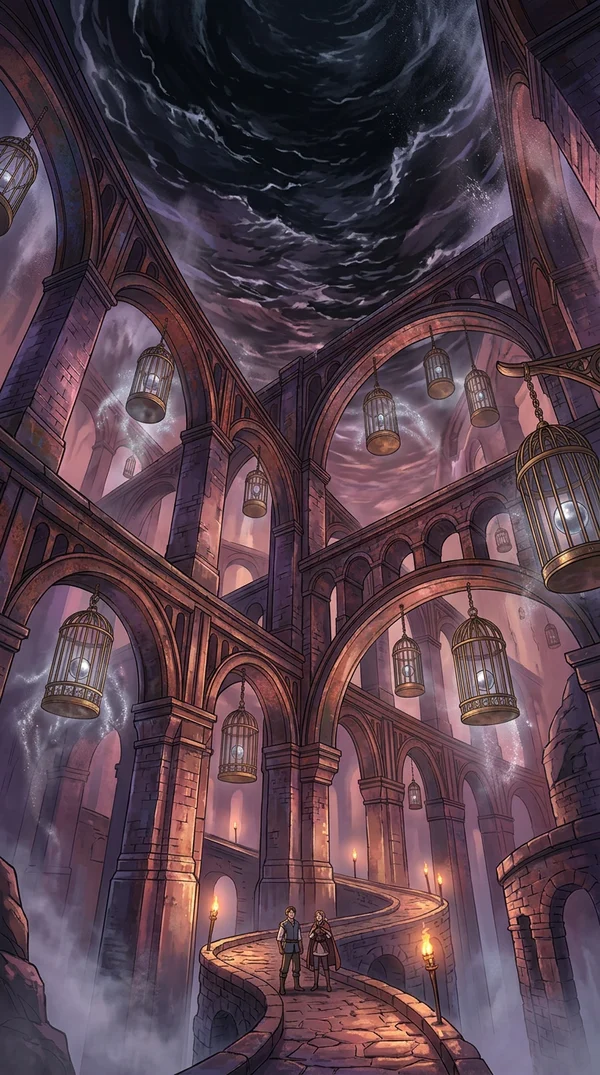
At a quarter to midnight we stand on the riverbank under the Ninth Street Bridge, where the market was two nights ago and will be again on Friday. The stalls are folded and chained. The snow has stopped. Above us, the bridge is yellow and enormous, its cables strung with Christmas lights that the city puts up every year, and under it the dark is the kind of dark that has a texture.
The river’s loud. The Allegheny never freezes the way people think it will.
“You hold my hand,” he says, “and you walk with me. When the city’s clocks finish striking, the underneath keeps going. Don’t let go until I tell you, and don’t look back.”
“What happens if I look back?”
“Nothing good.”
He holds out his hand.
I could make him take mine. I could stand here with my arms crossed in eight-dollar green velvet and a thrift-store peacoat and make the prince of the Hush reach for me, and he would, because he has to.
Somewhere across the river, a church bell starts to strike twelve.
I take his hand.
“Let’s go get engaged, Sal,” I say, and we walk into the dark under the bridge, and the dark goes on, and down.

What did you think?