Two Keys, chapter 1 of Two Keys in the Glovebox
My husband rolled his truck on the Turner Turnpike at 1:40 in the morning, and the woman in the passenger seat was my client of ten years.
I worked that out at 3:10, in the emergency room at Verdigris Regional, from her hair.
They had Zeke upstairs in CT. I was in a plastic chair outside bay eight, and the curtain on bay nine hadn’t been pulled all the way. Through the gap I could see a pillow, and on the pillow, a spread of blonde. Level-nine highlights, a fine weave through the crown. A violet gloss to kill the brass. The face frame pulled two shades brighter than the rest, because she liked to look lit from the front. Five weeks of warm brown regrowth at the part.
I had mixed that formula every six weeks for ten years. It was in my green ledger under D, in my own handwriting. Shiloh Dekker. She was due in my chair Monday at nine.
Zeke had told me he was in Ada.
I was still sitting there, holding my purse on my knees like a woman waiting on a bus, when a man stopped in the doorway at the end of the hall.
He was big, and wet to the knees, with a lineman’s climbing harness buckled on over his work clothes, a wide leather belt with steel rings at the hips. Red clay on his boots. He looked at the curtain, and then he looked at me, and I knew who he was before he said it, because I’d been hearing about him in my chair for a decade.
“Mrs. Dunn,” he said. “I’m Rocco Dekker.”
He lifted his right hand. Between two fingers he held two hotel key cards, black, each with a brass letter B, tucked in a paper sleeve with 614 written on it in ballpoint.
“These were in your husband’s glovebox,” he said.
I stood up. I don’t remember deciding to. My purse slid off my knees and landed on the tile, and neither of us picked it up.
“Where did you get those?”
“Trooper.” He tipped his head back toward the waiting room. “Glovebox came open when it rolled. Everything in it ended up on her side, so he bagged it all with her purse and gave it to me.” He looked at the cards as if they were something he’d found on a job and would have to write up. “He asked me if I wanted to sign for it. I signed for it.”
“The Boulder,” I said. It was on the sleeve, small, in brass-colored ink. The Boulder Hotel on Seventh Street in Tulsa. Dark wallpaper and a bar off the lobby. I had done a bride’s hair in that hotel two summers ago. I had stood in a suite on the fourth floor with a can of hairspray and told her not to cry until after the pictures.
“Room 614,” Rocco said.
“I can read.”
“I know you can.” There was nothing unkind in it. He said it like a man agreeing about the weather.
I knew more about Rocco Dekker than I knew about my own brother, and every word of it had come from his wife with her head in my shampoo bowl. Rocco worked too much. Rocco didn’t talk. Rocco had missed their tenth anniversary for an ice storm in Woodward and brought her a gas-station rose when he got home three days later, and she’d kept it in a bud vase until it went black, and I’d never been sure whether she told that story as a complaint or a brag. Rocco fixed the dishwasher at midnight. Rocco’s mother made bad banana bread. Rocco never once came into the salon.
He sat in the parking lot instead. Every six weeks for ten years, a gray Ram with a rack behind the cab, parked in the same spot by the dumpster with the engine off. One February, when the wind was coming sideways down Main Street, I took him a cup of coffee and set it on his hood because his window was up. He lifted two fingers off the steering wheel. That was the longest conversation we had ever had.
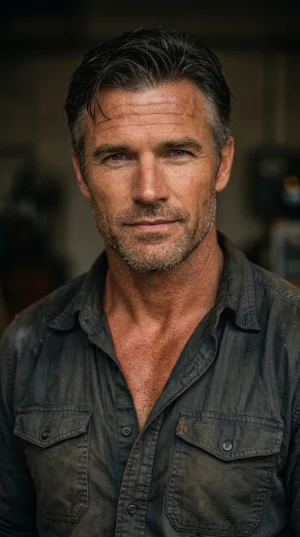
Up close he looked older than he did through the salon window, forty-something, gray coming in at the temples, a hard-hat line pressed into his hair. His eyes were very steady. He didn’t look like a man who had found out an hour ago. He had the look of somebody who’d been standing in a cold wind for a long time and had stopped noticing it.
“How did you get here before me?”
“I was up a pole on Kenosha when the hospital called. Wind took a tree into the line.” He glanced down at the harness as if he’d only just noticed it. “I left my hooks in the truck. Didn’t think about the rest.”
“You drove here in that.”
“I drove here in a co-op truck with the lights going. Nobody stopped me to ask about my belt.”
“Is she hurt bad?” I said.
He considered the question. I could see him doing it.
“Something in her chest. They’re watching it.” He nodded at the ceiling. “Yours?”
“Head and a wrist. They’re stapling his scalp.” I heard myself and almost laughed. I said it the way I’d say a client needed forty minutes under the dryer. “He gave them my name. He said, ‘Call my wife.’”
“Mine gave them hers,” Rocco said. “Her mother’s, I mean. In Catoosa. Where she told me she’d be tonight.”
Behind the curtain, a monitor beeped twice, settled, and went on beeping.
Marisol Ochoa came down the hall in purple scrubs with a chart against her chest. She was the charge nurse on nights, and she was also Deena’s mother, and Deena had the chair beside mine at Gloss. In Broken Arrow, everybody is two people away from your salon.
“Raina, mija.” Marisol touched my arm. “He’s back from CT. No bleed, just a concussion and that wrist. He’s sleeping. You can go sit with him.”
Then she looked at Rocco. Then at the key cards in his hand. Then at the gap in the curtain of bay nine.
Marisol has been a nurse for thirty years and she has a very good face for it. It didn’t move. She just looked, the way you’d look at a chart you’d already read and didn’t like, and then she said, “Mr. Dekker, she’s resting. I’ll come get you if anything changes,” and went on down the hall with her shoes squeaking.
By lunch, I thought, Deena would know. By dinner, half the Rose District.
“I’m going to wash my hands,” I said.
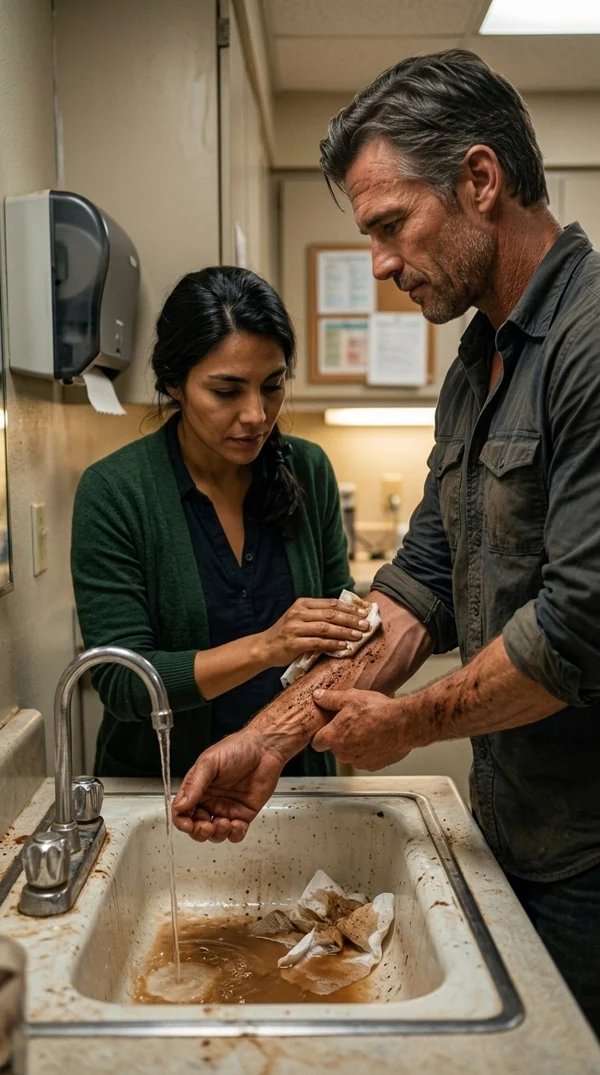
The bathroom across from the nurses’ station had a sign about flu shots and a sink with one of those faucets you have to hold down. I held it down. I let it run until it was warm and then I put the inside of my left wrist under it, where the burn scar is, a crooked line paler than the rest of my arm, from a curling iron when I was nineteen.
I test the water on my wrist before I touch a client. Every time, twenty years, without thinking about it. Too hot and you’ve scalded a woman who trusted you. Too cold and she flinches, and once a client flinches in your bowl she never really relaxes in your chair again. You learn to read a person by the water.
The water was right. My hands were steady. I looked at them under the light, at the color stain along my right thumbnail that never comes all the way out, and they looked like they belonged to somebody who knew what she was doing.
I looked at the rest of me in the mirror. My mother’s face looked back, brown and puffy-eyed under the hospital light, with her heavy eyebrows pulled down the way hers went when somebody lied to her at her own kitchen table. Sleep shirt. Jeans pulled on over bare legs. Hair in a clip. And over all of it the first coat I’d grabbed off the hook by the garage door at 2:30 in the morning, a navy fleece with HARGIS OILFIELD SUPPLY stitched over the heart.
His.
I took it off. I folded it in half and then in half again, the way we fold towels at the shop, and I put it in the trash can under the paper towels and pushed it down.
Then I went out to find Rocco Dekker.
He wasn’t in the hall. Marisol pointed at the sliding doors with her pen without looking up.
The storm had moved east toward Coweta and left the parking lot shining. Every puddle had a sodium light in it, orange and buzzing. Out past the ambulance bay, a co-op bucket truck sat across three spaces with its amber lights turning slow, around and around, painting the wet cars. Rocco was leaning against the side of it with his arms folded, the strap of the harness hanging down by his knee.
It was cold without the fleece. I didn’t care.
“You left your purse,” he said, and held it out. He’d picked it up off the tile after all.
“Thank you.” I took it. “Give me the key cards.”
He studied me a moment. Then he held them out too.
I took the sleeve. The cards were cool and slick and so light it seemed wrong. You’d think a thing like that would have some weight to it. You’d think you would feel it in your hand.
I turned it over. On the back of the sleeve, in the same ballpoint, somebody had drawn a small, lopsided heart.
I knew whose handwriting that was. She signed her credit card slip at my front desk every six weeks with a heart over the i.
“She’s coming Monday,” I said. “To the salon. She’s never missed an appointment in ten years. She’ll be in my chair at nine o’clock with her sternum taped up, telling me about her mother’s procedure.”
“Probably.”
“And he’ll come home Saturday and tell me about Ada.”
“Probably.”
“So what do I do, Rocco?” It was the first time I’d used his name out loud. It came out of me easier than it should have. “Tell me, because I’m a hairdresser and you’re a man in a harness at three in the morning and I don’t think either one of us knows.”
He unfolded his arms.
He reached out and took my hand, the one holding the sleeve, and closed my fingers over the two cards with his. His palm was rough and warm and much bigger than mine, and he didn’t let go right away. His thumb settled on the inside of my wrist, right on the scar, as if he’d known it was there. I could feel my own pulse under it. I could feel his.
Behind him the amber lights went around, and around, and lit his face and let it go.
“They’re both going to wake up and lie to us,” Rocco said. “Let them. Then we take back everything they took. And when it’s done, Raina, I’m taking you.”

What did you think?