Three Ten, Four Ten, chapter 2 of Two Keys in the Glovebox
I didn’t take my hand back.
That’s the part I’d tell you first if you asked me, and nobody ever has. A man I had spoken to once in ten years stood in a hospital parking lot in a climbing belt and said he was going to take me, and I stood there with his hand around mine and two hotel keys inside it, and I did not take my hand back.
“That’s a lot to say,” I said, “to a woman in her pajamas.”
“I’ve had a long night.”
“So have I.” The amber light came around and went away again. “You don’t know a thing about me.”
“I know you didn’t go sit with him.”
He let go then, slowly, as if he were setting something down that might tip. The air was cold where his hand had been. I put the key cards in the inside pocket of my purse and zipped it, and I zipped it again to be sure, and I heard myself breathe out.
“Okay,” I said. “Then let’s go in and let them lie.”
At 4:10 Zeke opened his eyes.
They’d moved him into bay eight. He had a line of staples across the top of his head like a zipper, and his left wrist in a splint up to the elbow, and a patch of road rash along his jaw where the window had come in. Somebody had washed most of the blood off his neck. They hadn’t gotten it out of his ear.
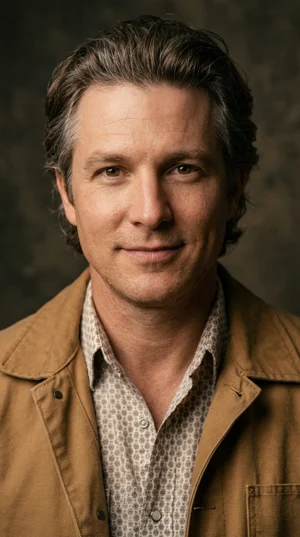
He was a handsome man. He still is. It’s the first thing anybody says about Zeke and the last thing they forget. Brown hair going silver in a way he paid me to leave alone, a laugh that made waitresses bring the check slower, a silver belt buckle the size of a saucer. He sold pumps and pipe and valves to men who didn’t need them, and they bought them anyway, because they liked him.
He looked at me and his face did what it always does, which is light up.
“Babe,” he said. “Oh, babe. Look at you. You came.”
“They called me.”
“I told them to.” He tried to sit up and thought better of it. “God, my head. I’m so sorry, Raina. I’m so sorry. I was coming back from Ada and I was just so tired, and it was raining, and I don’t even know what happened. One second I’m on the road and the next I’m upside down.”
I sat in the chair beside the bed and folded my hands in my lap.
I have stood behind a chair and listened to women lie for twenty years. Not mean lies, mostly. I’ve never had box dye. I only wash it twice a week. I don’t want it to look like I’ve had anything done. You learn not to argue. Arguing tells the client which part of her story you don’t believe, and then she fixes that part. You just nod and do a strand test, and the hair tells you the truth in twenty minutes.
“There was a woman in your truck,” I said.
“Shiloh.” He didn’t miss a beat. “Shiloh Dekker, from inside sales. Your Shiloh, babe, you do her hair. Her car quit on her at the branch in the city and she was stuck, and I said I’d run her home since I was coming through anyway. Is she okay? Nobody’ll tell me anything.”
“She’s next door.”
“Thank God.” He closed his eyes. “Thank God. I’d never have forgiven myself.”
Ada is a hundred miles south of Oklahoma City. Nobody comes back from Ada through the city. You’d have to want to.
“Okay,” I said.
He opened one eye at that. I don’t think I had ever said okay to Zeke without a but behind it. He looked at me, and I looked back with the face I use when a client tells me she’s never had box dye, and after a second he smiled and reached for my hand with his good one.
“Where’s my phone?” he said. “And the truck. Where’s the truck? Did they say where they towed it?”
He asked about the truck before he asked about the woman in it. I wrote that down later. I wrote all of it down later.
Marisol brought his things in a clear plastic bag with a drawstring and handed it to me, not to him. “Personal property, released to spouse,” she said, and held out a clipboard for me to sign. “The trooper left you a copy of his list.”
Wallet. Boots. A phone with a crack across it like a spiderweb. A key fob for the truck. A pink carbon of a highway patrol inventory sheet, filled out in block capitals by somebody with cold hands.
2022 FORD F-250 WHT. DIR OF TRAVEL: EB. I-44 TURNER TPK E OF STROUD. DRIVER STATES HE WAS OPERATING VEH. BOTH OCC TRANSPORTED AIR MED.
That was how a wreck east of Stroud had ended up in my town, fifteen minutes past Tulsa. They’d both been flown, one helicopter each, and both Tulsa trauma centers had been full with the storm that night, so the helicopters brought them to Verdigris Regional and its new ER.
And under Items released, with a line drawn to driver door pocket:
RECEIPT (BOULDER HOTEL)
I gave Zeke his phone. He turned it face down on the blanket so fast I almost missed it.
The receipt was folded in thirds at the bottom of the bag. I didn’t open it in front of him. I took the bag to the bathroom across the hall, the one with the faucet you have to hold down, and I stood in there with the door locked and unfolded it against the mirror.
The Boulder Hotel. Guest: Ezekiel Dunn. Room 614. Arrival 09/29/26. Departure 10/01/26. Guests: 2.
Two nights. Six hundred and eighteen dollars and forty-seven cents. Room service on Tuesday night, a steak and a Caesar salad. A bar tab: two Old Fashioneds, which is what Zeke drinks, and a French 75.
In August, with her head tipped back in my bowl, Shiloh Dekker had told me about the first French 75 she’d ever had. Gin and champagne and lemon. She’d said it tasted like being somebody else. I had laughed and told her to bring me one.
I said one word to the mirror, in Spanish, the one my mother saved for men who parked across her driveway.
I put the receipt in my purse beside the key cards. I put the truck fob in there too. Then I put the bag of his boots and his wallet back together and carried it out and set it on the end of his bed, and he was asleep again, with his good hand resting on his phone.
Rocco was in the family room at the end of the hall holding two vending-machine coffees, one in each hand, as if he’d been waiting to see which of us needed it first.
“She’s awake,” he said.
“So’s he.” I took a cup. “He says her car quit at the branch in the city and he gave her a ride.”
Rocco pulled a small yellow notebook out of his shirt pocket, the kind with the waterproof pages, and a carpenter’s pencil. He wrote something. His handwriting was small and square.
“She says her mother’s procedure got moved,” he said. “She went to the city with the girls from work for a dinner. Her car died in a parking garage in Bricktown, and Zeke was there and offered.”
“At the branch,” I said. “Not a garage in Bricktown.”
“At the branch.” He wrote that down too. “They’ll fix it by tonight.”
“How do you know?”
“Because one of them will call the other one.” He tapped the pencil on the page. “And then it’ll match, and it’ll be wrong in the same way, and that’s fine. I don’t need it to be true. I need it written down.”
He’d brought the trooper’s bag out with him. Her purse was in it, a tan leather tote, and a scatter of glovebox paper, an owner’s manual, napkins, a tire gauge. He looked at my pink carbon a long time, the way I’d look at a color formula somebody else had written. Then he looked at his own.
“Which side did they find her purse?” he said.
“What?”
“Nothing.” He folded the sheet and put it in the notebook. “Just writing things down.”
Out in the hall, the two flight medics who’d brought them in were restocking a bag and talking about the rollover, the way people talk who’ve seen a hundred of them. Had to cut the driver’s door. Seat was jammed so far up on the wheel I don’t know how a big old boy like that fit in it. One of them laughed. Rocco didn’t look up, but his pencil stopped on the page for a moment and then went on.
He reached into the trooper’s bag again and came out with something small, and held it out to me on his palm.
A gold earring. A little horseshoe, the size of a fingernail, with a chip of diamond in the toe.
“It was loose in the bottom,” he said. “The other one’s still in her ear.”
I knew it. At the end of August I had taken both of them out of Shiloh Dekker’s ears myself and held them in my palm while I foiled the hair at her nape, so the color wouldn’t stain the gold. Aren’t they cute? she’d said. A gift. She hadn’t said from who, and I hadn’t asked. You don’t ask. People tell you, sooner or later, if you just keep your hands moving.
I took it off his palm and put it in my purse with everything else.
He had clay dried on his forearms, red as brick, flaking at the edges where the rain had run through it. He was going to walk back into his wife’s bay like that. I didn’t like it.
The family room had a little sink in the corner beside a coffee maker nobody had cleaned since the Clinton administration. I ran the water. I put my wrist under it without thinking, the inside of my left wrist, until it was right.
When I turned around he was watching me.
“Give me your arms,” I said.
He set his coffee down and held them out, palms up. I wet a wad of paper towels and washed the clay off him, from the elbow down, one arm and then the other, the way I’d rinse color from a client’s hairline, working toward the hands. He had a burn of his own on the back of his right hand, white and shiny. A nick across one knuckle. His skin was cold from the night, and it warmed under the water, and under my hands.
He didn’t say anything. He didn’t move. He just let me.
It was the most intimate thing I had done with a man in two years. I knew it while I was doing it. I think he did too.
When I was finished I dried him with a fresh towel and threw it away and stood there with my wet hands, and he looked down at me.
“You test it,” he said. “The water. On your wrist.”
“Every time.”
“Why?”
“So I don’t hurt anybody who trusted me.”
Something moved in his face, and then it was gone.
“Here’s how we do it,” he said. He said it low. A nurse went by the door with a wheelchair. “We don’t confront them. We don’t cry in front of them, we don’t throw anything, we don’t tell a single soul what we’ve got in your purse. We let them talk. Every lie they tell, we say thank you, and we write it down with the date and the time.”
“Like a strand test.”
“I don’t know what that is.”
“It’s when you don’t argue with a woman about what’s on her hair. You put a little developer on a piece of it and wait, and the hair tells you.”
He thought about that. “Then like a strand test.”
“How long do we wait?”
“His insurance will call him today. They’ll want a recorded statement. Where he’d been, where he was going, who was in the truck, who was driving. Hers will want the same for her bills.” He picked up his coffee again. “A man will say anything to his wife at four in the morning. He’s more careful with a company that has lawyers. That’s the version he’ll have to keep.”
“And it’ll be wrong.”
“And it’ll be his.”
I looked down the hall toward bay eight, where my husband was asleep with his hand on his phone, and toward bay nine, where the curtain was closed all the way now.
“They’ll lie in front of us and we’ll say thank you,” Rocco said. “And we’ll have it in writing by Sunday.”
Marisol came around the corner then, with her chart, and stopped in the doorway. She looked at me in a way I didn’t like. It was too kind.
“Raina, honey,” she said. “Shiloh’s awake. She asked me to tell you she’s real sorry about all this mess.” Marisol paused. “And that she’ll still be in Monday at nine.”
What did you think?